National Biosafety Month Is a Good Time to Audit Your Lab's Decontamination Protocol
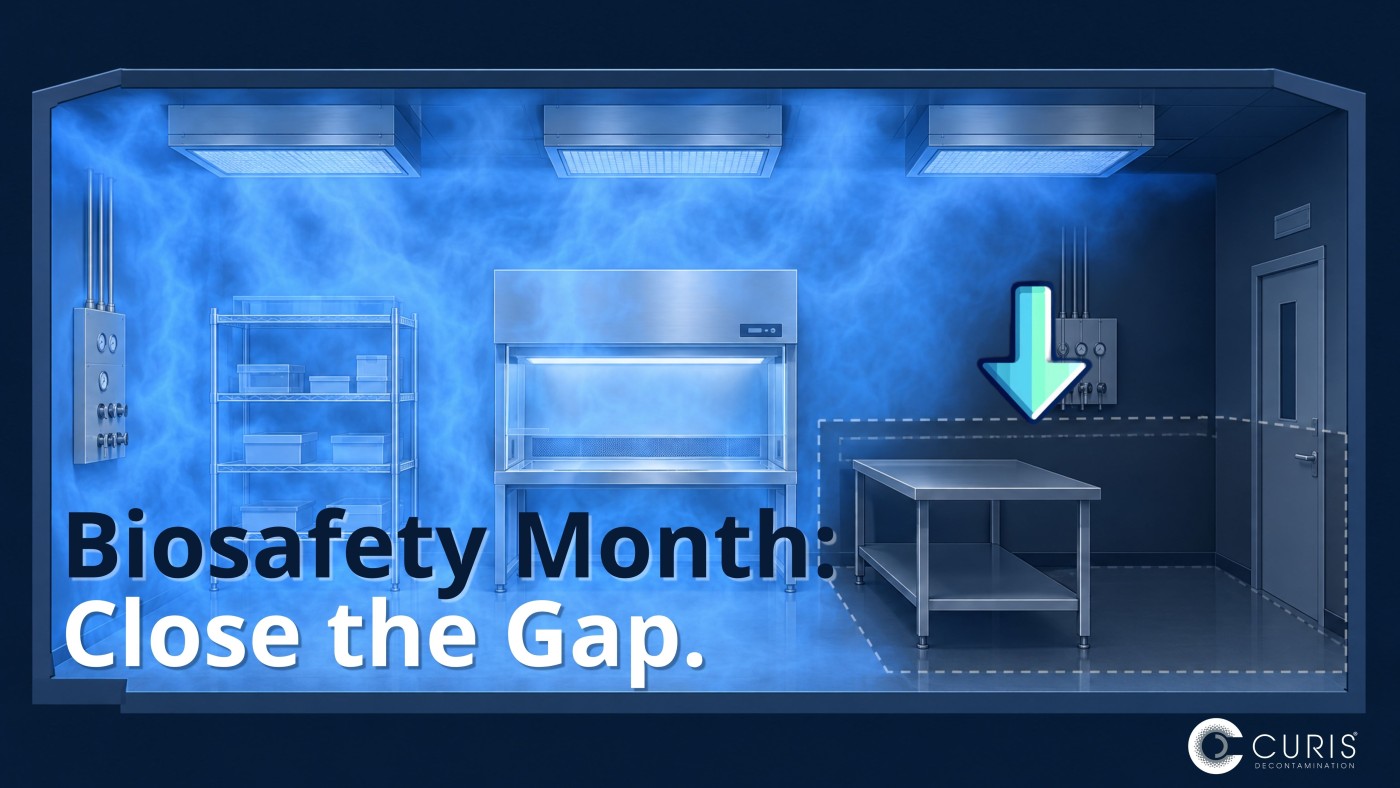 October is National Biosafety Month—the annual prompt from ABSA International for facilities running biological research to review their biosafety practices.
If you're a biosafety officer, you're already in review mode. SOPs refreshed. Training records confirmed. BSC certification current.
But there's one audit item that's often missed:
When did you last perform a validated, documented whole-room biodecontamination cycle?
For many labs, the answer is uncomfortable. Decontamination happened reactively—after a spill or an incident. Or it's been long enough that no one is sure. Or the protocol exists somewhere but hasn't been tested against current operations.
Biosafety Month is a useful prompt. Use it to audit not just your lab's paperwork, but your biodecontamination program. Here are the six points that a complete audit should cover—including a few that some facility reviews surprisingly skip.
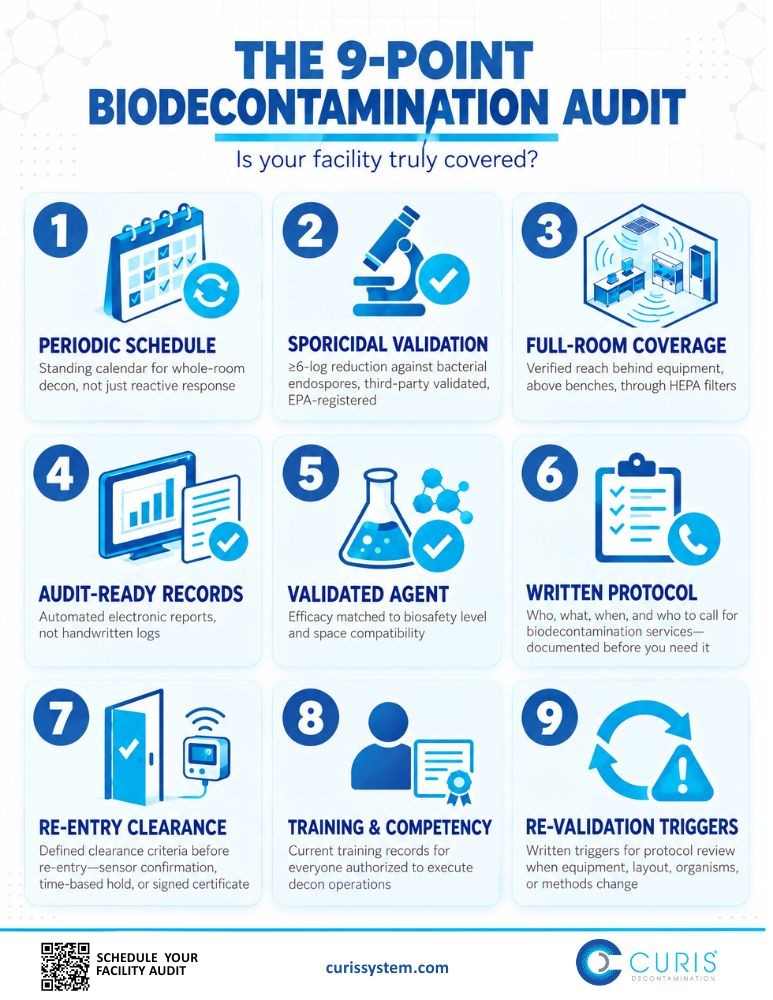
The 9-Point Biodecontamination Audit
1. A Documented Periodic Schedule
Reactive decontamination—after a spill, exposure event, or change in research activity—is necessary, but not sufficient. A complete program includes a standing periodic schedule: predetermined dates, defined scope, and documented sign-offs.
Whether you handle decontamination internally or rely on contracted biodecontamination services, a documented periodic schedule is the foundation of a defensible program.
 2. Validated Sporicidal Efficacy
Not all decontamination methods are created equal, and the standard matters. Sporicidal efficacy means a ≥6-log reduction against bacterial endospores—the benchmark for sterilization-grade assurance in critical environments—and a higher bar than surface disinfection of fungal spores. For an overview of why that distinction matters, see our blog on understanding bacterial versus fungal spores.
Ask whether your current method has documented, third-party validated sporicidal claims—and whether that validation is appropriate for the biosafety level and organisms your lab works with. If the answer is uncertain, that's a gap.
3. Full-Room Coverage Verification
Manual decontamination methods—surface wipes, unvalidated fogging—routinely miss hard-to-reach areas: behind equipment, above bench height, through HEPA filter banks. Vapor-phase methods, including vaporized hydrogen peroxide (VHP) and hybrid hydrogen peroxide™ (HHP™) systems, distribute more comprehensively, but not all are created equal.
Does your current method have validated coverage data, or are you assuming it reaches everywhere it needs to? Consistent coverage gaps in an unvalidated program don't appear in routine environmental monitoring results until something goes wrong.
Curious about the differences in whole-room decontamination technologies? Take a deeper dive with...
- Not All Low-Concentration Hydrogen Peroxide Systems are Created Equal
- Hydrogen Peroxide Biodecontamination—AHP, VPHP, HHP: What is the Difference?
- Beyond Legacy H2O2 Methods: The Evolution of Hybrid Hydrogen Peroxide™ Technology
4. Inspection-Ready Documentation
Whole-room biodecontamination cycles should generate the same quality of documentation as any other controlled operation: location, cycle parameters, agent identity and concentration, operator on record, and duration.
Immutable, automated electronic data reports—not handwritten logs reconstructed after the fact—are the standard GMP / FDA reviewers expect. If your decontamination records couldn't survive an audit today, they won't survive one tomorrow.
5. A Validated Agent
Your decontamination agent should have validated sporicidal efficacy claims appropriate to your biosafety level. Not every agent does. Some leave harmful chemicals at the concentrations needed for efficacy. Confirming your agent is both effective for the organisms you work with and appropriate for the space is a basic audit step that sometimes gets skipped.
6. A Written Protocol
When whole-room decontamination is needed—urgently or on schedule—the operational questions should already be answered: Who authorizes it? What agent is used? What are the application parameters? How long before re-entry? And who will you call for expert assistance or biodecontamination services if you need them?
If those answers live only in the institutional knowledge of one person, you don't have a protocol—you have a dependency. A written protocol survives turnover, shift changes, and emergencies.
7. Do you have defined re-entry clearance criteria?
A documented decontamination cycle isn’t the same as a confirmed safe space. Your protocol should specify exactly how clearance is determined before personnel re-enter—whether that’s sensor confirmation that agent concentration has dropped below the established TWA threshold, a time-based hold with documented rationale, or a signed certificate of decontamination. “We waited long enough” isn’t a clearance standard. If your current protocol doesn’t define this explicitly, it’s worth closing that gap before your next inspection or incident review.
8. Are training and competency records current for everyone involved in decon operations?
In any regulated or BSL-2+ environment, it’s not enough for the right person to know how to run a decontamination cycle—there should be a record that they’ve been trained, and that the training reflects your current protocol. If personnel have changed, roles have shifted, or your method has been updated, your training documentation needs to keep pace. Auditors and biosafety officers flag this regularly: the competency gap isn’t always in the method, it’s in the paperwork trail for who’s authorized to execute it.
9. Have you defined what triggers a re-validation?
A decontamination protocol that was validated when the lab was configured one way may no longer reflect what’s actually happening in the space. New equipment installations, room layout changes, a shift in research activities, or the introduction of new organisms can all affect how well your current method performs. A mature biosafety program defines in writing what events require a formal protocol review or re-validation—so the decision isn’t left to judgment in the moment. If your written protocol doesn’t include a change-control trigger list, that’s a gap worth adding before the next significant change arrives.
Closing the Gap with Hybrid Hydrogen Peroxide™ Technology
Hybrid Hydrogen Peroxide™ (HHP™) technology addresses most of the gaps above in a single, automated system. Like vaporized hydrogen peroxide (VHP), CURIS HHP™ systems distribute hydrogen peroxide uniformly throughout a treated space. The vapor reaches surfaces manual methods miss and decomposes into water vapor and oxygen, leaving no harmful residues or metals to wipe off.
For facilities running biosafety laboratories (BSL-1–4) work—animal research, recombinant DNA, infectious disease models—HHP™-based biodecontamination can be built into routine lab operations rather than reserved for emergencies.
Biosafety Month is a useful prompt. If your program can't answer yes to all six of the above—you've left an essential part of the audit undone.
Frequently Asked Questions
How is vaporized hydrogen peroxide different from liquid disinfectants?
Vaporized hydrogen peroxide distributes like a gas throughout the full treated volume, including the air, reaching surfaces contact-based disinfectants can't access—behind equipment, inside HVAC registers, at ceiling height. Liquid disinfectants require manual application and leave coverage gaps that accumulate over time.
How long does a whole-room biodecontamination cycle take?
Cycle times vary by room size, agent concentration, and humidity conditions. CURIS® systems typically complete their sporicidal treatment within 45–90 minutes, or less depending on the size of the space—with aeration dependent on facility design.
What documentation does a biodecontamination system generate?
CURIS® systems log cycle parameters in real time, including operator, location data, cycle duration, and more. Logs are exportable for your facility's compliance and inspection records.