Why ATMP Manufacturers Need Biodecontamination That Fits the Process—Not Just the Room
Your Process Changes Every Quarter. Your Contamination Risks Don’t.
The cleanroom looks the same on Monday whether you’re running a viral vector expansion or switching to a cell therapy harvest. The HEPA housings, the gasket seals behind fixed equipment, the material airlock surfaces—none of them care what product is in the suite. They collect bioburden either way.
That’s the operational reality facing facilities in biologics manufacturing, particularly those producing Advanced Therapy Medicinal Products. ATMP workflows—cell therapies, gene therapies, viral vector-based treatments—are built around variability: small batches, short shelf lives, processes that evolve between clinical phases, and materials that cannot be terminally sterilized. Upstream processing activities (cell expansion, inoculation, media preparation) and downstream steps (purification, filtration, formulation) each carry distinct contamination risks—and both demand aseptic processing conditions throughout. But the contamination control infrastructure those products depend on still needs to deliver a validated, documented baseline every time the suite turns over.
The mismatch shows up in practice. The cleanroom doesn’t change between products—but the process inside it does: different cell lines, different vectors, different raw materials, different equipment on the bench. Each changeover introduces cross-contamination risk that demands a validated, documented decontamination baseline before the next campaign starts. A CDMO rotating multiple clients through the same suite needs that confidence after every turnover. So does any facility where the contamination risk profile shifts with each product even though the room classification stays the same. When Annex 1 calls for a Contamination Control Strategy that integrates facility design, equipment, environmental controls, and personnel practices, that strategy has to deliver consistent results across all of those shifting workflows—not just within one fixed process.
The answer isn’t a bigger cleanroom or a more expensive isolator. It’s a process-centric approach to contamination control—a biodecontamination strategy as flexible as the processes it protects—one that works at room scale, airlock scale, and equipment scale, with the same validated chemistry and documentation trail regardless of what product is on the schedule.
Flexible Biodecontamination: Rooms, Airlocks, Equipment, and Everything Between
This is where the conversation shifts from where you process to how you decontaminate.
A manufacturing environment that supports ATMP workflows needs validated biodecontamination that supports aseptic processing at every scale—not just inside a single piece of equipment.
Cleanrooms and suites.
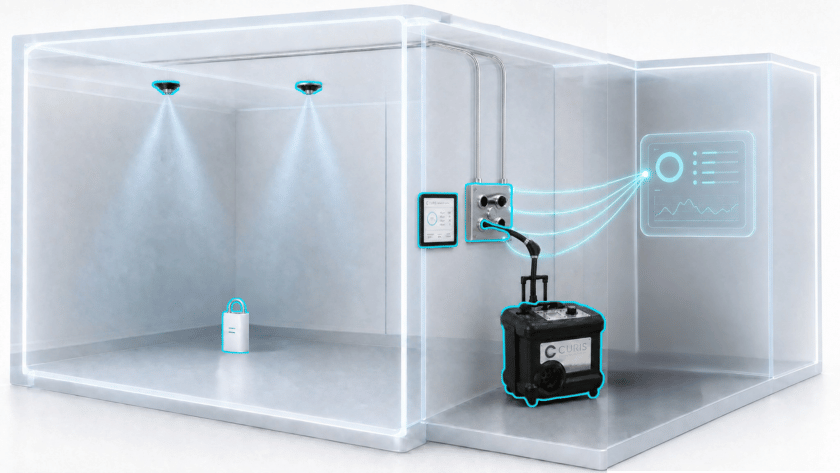 Between campaigns, between product types, or after an environmental monitoring excursion, the entire manufacturing space needs to return to a validated baseline. Automated hybrid hydrogen peroxide™ (HHP™) fumigation, a low-concentration version of vaporized hydrogen peroxide (VHP) fumigation delivers consistent, documented sporicidal treatment across the full volume—including HEPA housings, behind fixed equipment, and along seams and gaskets that manual wipe-down cannot reliably reach.
CURIS System’s BMS Link System™ is designed for exactly this—permanently installed biodecontamination integrated with your building management system, so room-scale treatment runs on schedule or on demand with documented cycle records feeding directly into your facility’s data infrastructure.
Material airlocks and transfer zones.
Every item entering a classified space is a potential contamination vector. Transition points—receiving docks, material airlocks, pass-throughs—are where contamination risk concentrates. Automated decontamination of these transfer environments removes the operator-to-operator variability that manual spray-and-wipe introduces, and it generates cycle records that support your Contamination Control Strategy (CCS) documentation.
The BMS Link System™ with the CURIS 3 extends to airlock and transfer zone integration as well, tying decontamination cycles to door interlocks, pressure monitoring, and automated sequencing—so the transfer pathway is validated and documented without relying on manual operator steps.
Equipment and instruments.
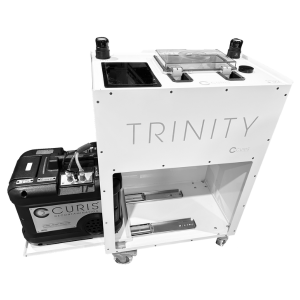 Biosafety cabinets, isolators, cell sorters, centrifuges, and analytical instruments all require decontamination—and isolator decontamination in particular is a growing requirement as more ATMP facilities adopt barrier technology—some on a routine schedule, some between product changeovers, some after a contamination event. The CURIS TRINITY™ easily quick-connects to equipment for closed-loop decon (a biosafety cabinet housing, a glove bag, or the instrument’s own containment) with the same validated chemistry used at room scale.
Scalable by design. The key is a single, validated chemistry and delivery engine that adapts to the application. The CURIS 3 decontamination unit is the core of the system—operating independently for whole-space treatment, integrated into rooms and airlocks through the BMS Link System™, or deployed inside the TRINITY™ for equipment-scale decontamination. One validation lineage, one training framework, three deployment configurations. Your decontamination program adapts to whatever the process demands—today and when that process changes next quarter.
Beyond Microbial Kill: Why DNA-Free Matters for Cell and Gene Therapy
Here’s something the conversation about ATMP contamination control often misses: for facilities relying on PCR-based testing, being microbiologically clean isn’t enough. You also need to be DNA-free.
Cell and gene therapy manufacturers use PCR and qPCR throughout their workflows—for identity testing, mycoplasma testing, adventitious agent screening, sterility testing, and viral clearance verification. Every one of those assays generates amplicons: short, chemically stable DNA fragments that survive routine surface cleaning, accumulate on internal instrument surfaces, and produce false-positive results that are indistinguishable from genuine contamination.
False positives in ATMP manufacturing aren’t just an analytical nuisance. When your product has a 24-hour shelf life, a false-positive sterility or mycoplasma result can mean a discarded patient dose and a delayed treatment. When a contaminated PCR instrument produces unreliable results across multiple runs, the investigation, remediation, and revalidation cycle can take weeks or cost you a whole new device.
CURIS System recently published data from two independent evaluations of Hybrid Hydrogen Peroxide™ vapor for DNA amplicon inactivation—and the results are directly relevant to ATMP environments.
Field recovery of contaminated instruments.
In a collaboration with Biosafety International and The Kirby Institute (University of New South Wales), Cepheid GeneXpert PCR instruments carrying naturally occurring amplicon contamination from clinical use were treated with low-concentration HHP™ vapor. Across three devices and 54 sampling locations—including fan blades, cartridge bays, and module interiors—no amplifiable DNA was detected after treatment. The program has since recovered more than 40 instruments to service, avoiding over $1.2 million in replacement costs.
Controlled quantitative challenge.
In a separate evaluation conducted by MilliporeSigma in collaboration with Fisher Scientific, known quantities of plasmid DNA were placed at 11 locations throughout a controlled-environment laboratory. HHP™ vapor produced complete inactivation of the 120 bp target at challenge populations up to 924.5 starting copies across all locations, even under unfavorable fumigation conditions where the room could not be fully sealed.
Both studies used CURIS® decontamination equipment running 7% low-concentration hydrogen peroxide with patented Pulse™ delivery—the same chemistry and platform used for room-scale and equipment-scale biodecontamination in pharmaceutical environments. The vapor reaches internal instrument surfaces (fan assemblies, vent paths, cartridge bays) that manual wipe-down with bleach or DNA-degrading agents cannot access, and it does so without damaging the sensitive electronics, optics, and calibrated components that make aggressive chemistries impractical for routine use.
For ATMP manufacturers, this means your biodecontamination program can address both microbial contamination and residual nucleic acid contamination with the same validated system—without introducing a second chemistry, a second validation package, or a material-compatibility risk.
Documentation and CCS Alignment
Annex 1 expects biodecontamination to be documented, repeatable, and integrated with environmental monitoring. For ATMP manufacturers navigating inspections across multiple regulatory frameworks (EU GMP, FDA cGMP, ICH Q9 Quality Risk Management), that documentation trail matters—and it aligns directly with Quality by Design (QbD) principles that expect contamination control to be built into the process, not layered on after the fact.
Automated hydrogen peroxide vapor cycles generate time-stamped records of cycle parameters, environmental conditions, and biological indicator outcomes—the kind of reviewable, reproducible evidence that supports both your CCS documentation and your inspection readiness. When those records come from a system that operates across rooms, airlocks, and equipment, you get a consistent data format and a single validation lineage instead of a patchwork of different methods, different documentation formats, and different qualification packages for each space.
A Practical Starting Point
You don’t need to redesign your facility or commit to a single proprietary platform to get flexible, validated biodecontamination into your ATMP workflows. The practical path starts with the spaces where contamination risk is highest and documentation gaps are most visible:
- Between campaigns or product changeovers, where cross-contamination risk is greatest
- Material transfer zones, where operator variability introduces the most inconsistency
- PCR and molecular testing areas, where amplicon contamination threatens assay reliability
- After environmental monitoring excursions, where a faster, documented return to control reduces downtime
CURIS System provides portable and integrated biodecontamination solutions that scale from individual equipment enclosures to full cleanroom suites—using a single EPA-registered chemistry, a single validation approach, and a single documentation framework. Whether your cell and gene therapy manufacturing operation is running autologous treatments at clinical scale or scaling up viral vector production for commercial supply, the decontamination program should be built to move with you.
Ready to evaluate how flexible biodecontamination fits your ATMP manufacturing environment? Contact a CURIS System subject matter expert for a facility assessment.