Is a Handheld PPM Check Enough? Continuous Hydrogen Peroxide Monitoring from Cycle Start to Reentry
Beyond Pass/Fail: Why Your Decontamination Cycle Needs a Continuous Record
The cycle is done. The generator reports aeration complete. Now someone needs to confirm the space is safe to enter.
At many facilities, that means donning a respirator with the appropriate cartridges, entering the treated space, and walking a handheld low-level hydrogen peroxide sensor through the room—checking levels at multiple points before anyone else sets foot inside. It's the standard practice, and for good reason: a single reading at the doorway can't account for concentration gradients, dead zones, or areas where aeration lags behind the rest of the space.
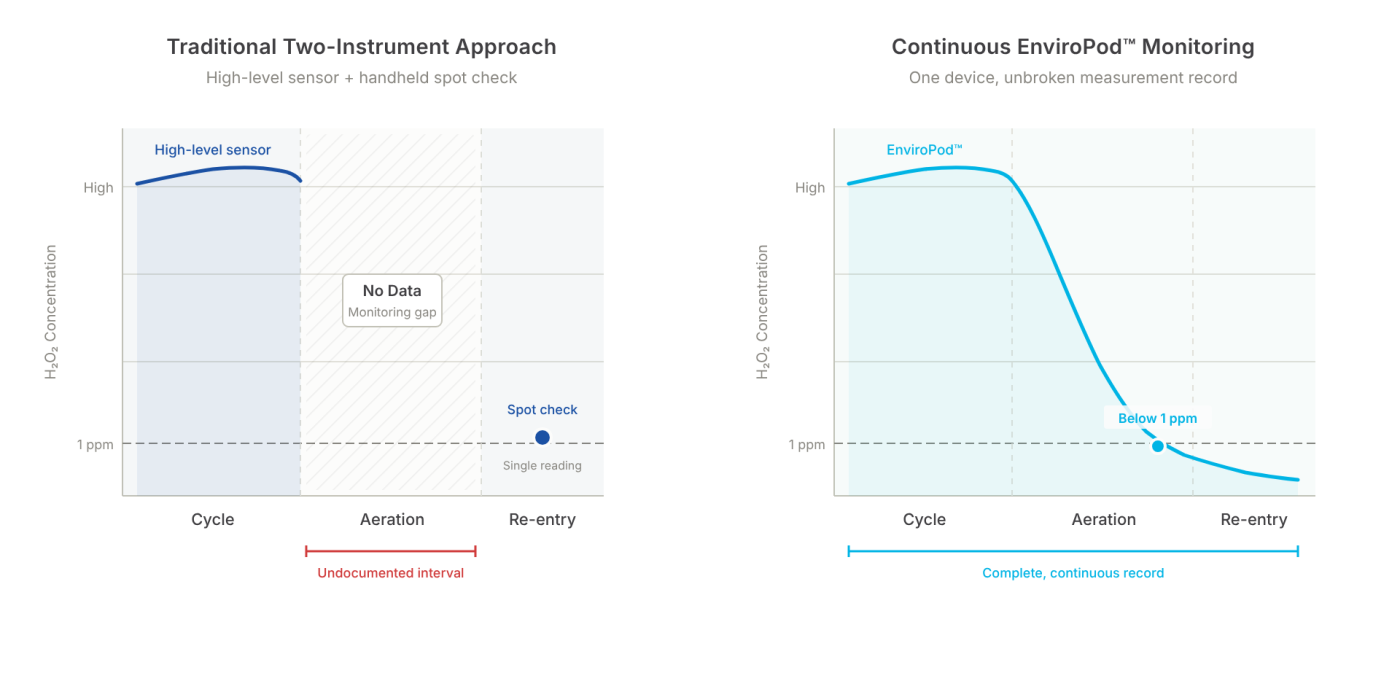
The walk-through is careful, deliberate, and necessary. But it still captures one set of readings at one moment. It tells you where levels are right now—not what happened during the cycle, how evenly vaporized hydrogen peroxide (VHP / VPHP) is distributed, or how aeration actually progressed from peak concentration to reentry conditions.
That's a meaningful gap. And it starts with a basic limitation of hydrogen peroxide sensors.
The Sensor Dilemma
Hydrogen peroxide monitoring during biodecontamination cycles requires two different measurement ranges—and conventional sensors can only handle one.
High-level sensors track the concentrations needed for an effective kill phase, but they lack the precision to distinguish between 0.8 ppm and 1.2 ppm at the end of aeration. Low-level sensors have that resolution—they're built for occupational exposure monitoring—but they saturate when hydrogen peroxide condenses on the sensing element during high-concentration phases. That's why they stay out of the room until the cycle ends.
The handheld walk-through is a workaround for this limitation. One instrument handles the cycle. A different instrument checks the endpoint. And nothing connects them into a continuous record of what happened in between.
What Gets Lost in the Handoff
Even a thorough walk-through with a handheld sensor captures conditions at the moment you enter—not during the cycle itself. It doesn't record:
 Peak hydrogen peroxide concentration during the dwell phase
- Relative humidity during active VPHP distribution
- Spatial uniformity—whether all zones reached target concentration
- The aeration curve: rate of decline, stalls, and zone-to-zone variation
For routine operations, the combination of biological indicators, generator logs, and a post-aeration walk-through gets the job done. But when a deviation occurs, when an auditor asks for evidence, or when you need to optimize cycle parameters—those questions demand a continuous environmental record. And the two-instrument workaround doesn't produce one.
Bridging the Gap
The CURIS® EnviroPod™ environmental conditions monitor was designed to stay in the treated space from cycle start through your facility's approved reentry levels—eliminating the handoff between instruments and the gaps in the record it creates.
Its patent-pending design helps the low-level sensing elements avoid exposure to high hydrogen peroxide concentrations during the active phases of the cycle—mitigating the saturation that forces conventional low-level sensors out of the room. The result is dual-range measurement—from sub-ppm resolution through peak cycle concentrations—in a single device, with no instrument swap.
Alongside hydrogen peroxide, the EnviroPod™ monitor continuously records temperature and relative humidity—the environmental factors that directly influence vapor distribution, condensation behavior, and aeration rate.
 Throughout the cycle, the EnviroPod™ monitor remotely streams live data to the CURIS Decon App—giving your team real-time visibility into cycle conditions from outside the treated space. No respirator. No entry. Your team can monitor concentration and humidity trends as they happen, flag anomalies before they become deviations, and confirm aeration progress without opening the door.
That visibility also changes how long the process takes. Without continuous data, many facilities pad dwell and aeration times with conservative overestimates—because when you can't see what's happening inside the space, the safe move is to wait longer than you probably need to. With live EnviroPod™ data streaming to the CURIS Decon App, your team can see when target conditions are actually met and move to the next phase based on measured data rather than estimates. The result is faster room turnaround without compromising the integrity of the cycle.
After the cycle, the complete environmental record is available for download and integration into batch records.
In larger or multi-zone spaces, multiple EnviroPod™ units provide spatial coverage—each streaming independently to the same app view, so your team sees the full picture across the entire treated area, not just a single point.
From Spot Check to Continuous Record
A continuous environmental record doesn't replace biological indicators, validated cycles, or standard operating procedures. It connects them.
Right now, a typical decontamination cycle produces several separate outputs: generator run logs, biological indicator results, and a handheld reentry reading—each documented independently, often in different formats, by different people. When a deviation investigation, an audit, or a cycle-optimization review comes up, your team pieces the story together from multiple reports after the fact.
EnviroPod™ changes that equation. Because it captures hydrogen peroxide concentration, temperature, and relative humidity continuously from cycle start through your facility's approved reentry levels—and delivers that data through the CURIS Decon App—your team gets a single, time-stamped environmental record for every run. One cycle, one record, one place to look.
That kind of visibility supports the decisions that matter most:
- Deviation investigations built on a complete timeline rather than reconstructed notes
- Cycle-to-cycle comparison that detects drift in room tightness or HVAC behavior before it becomes a problem
- Qualification profiles based on measured data rather than modeled estimates
- Audit responses backed by a record that speaks for itself
The question isn't whether your decontamination cycle works. It's whether your records can prove it did—completely, for every run, without assembling the evidence from separate sources after the fact.
The EnviroPod™ monitor makes that possible.
Learn how the EnviroPod™ monitor integrates with your decontamination program.