How Biodecontamination Fits into Your Annex 1 Contamination Control Strategy
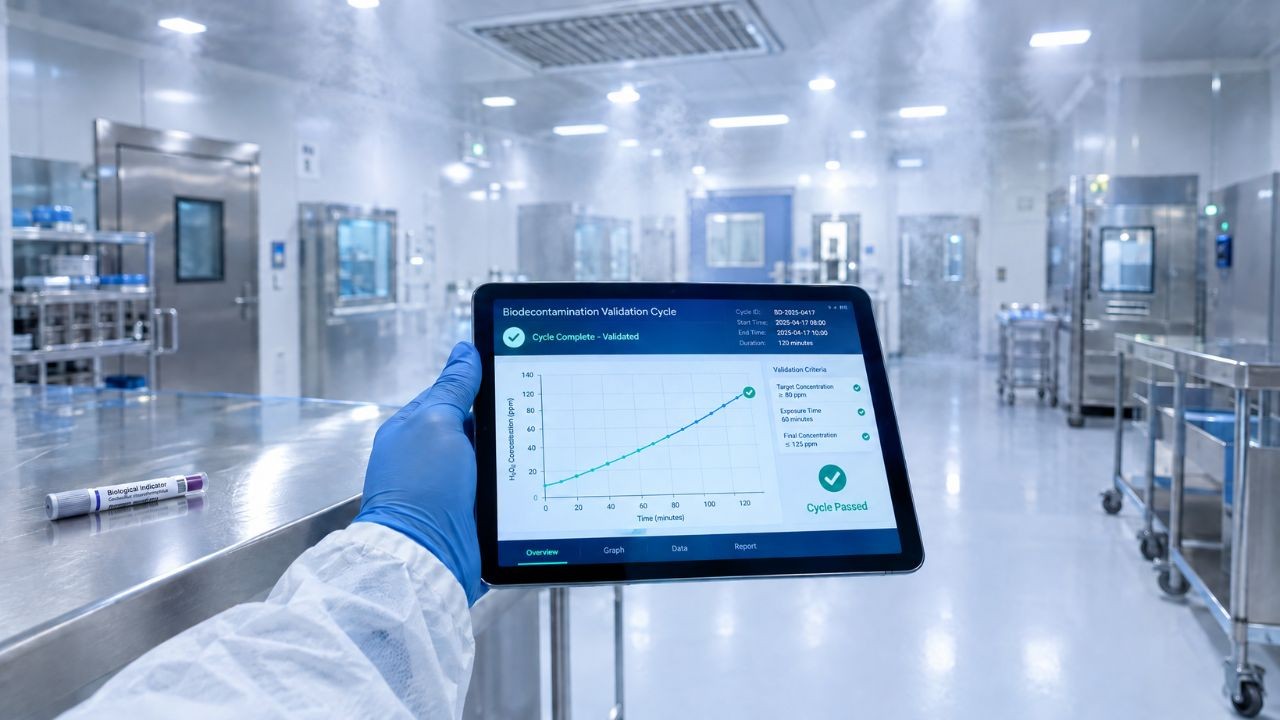 Three years after the revised EU GMP Annex 1 took effect, most facilities have a CCS document. Fewer have closed the loop on biodecontamination—the step regulators expect you to validate, document, and demonstrate is actually working.
Your CCS Document Exists. Does Your Decontamination Program Support It?
Since August 2023, the revised EU GMP Annex 1 has required every sterile-product manufacturer to maintain a Contamination Control Strategy (CCS)—a living document that maps every contamination vector in your facility, assigns controls, and demonstrates that those controls work together as a system.
Most facilities responded quickly. CCS documents were drafted, risk assessments completed, and contamination sources cataloged. But three years into enforcement, a pattern has emerged during inspections: the document says one thing about biodecontamination, and the facility does another.
The gap is rarely intentional. It forms because Annex 1 treats biodecontamination as a validated process—on par with sterilization—while some facilities still document it like a routine cleaning task. That mismatch is where inspectors look, and where environmental monitoring (EM) excursions often trace back to.
What Annex 1 Actually Expects from Biodecontamination
 The revised guidance is method-agnostic. It does not name a required biodecontamination method, and it does not write a numeric log-reduction figure into the regulation itself—it sets a performance expectation and leaves each facility to demonstrate it holds up. Three requirements stand out for facilities evaluating how their current program—manual disinfection, automated fumigation, or both—fits within their CCS:
-
Validated efficacy in the manner you actually use it.
- Section 4.3 requires that “the effectiveness of disinfection and detergent agents” be validated—specifically, in the manner the product is actually applied (spray, wipe, presaturated wipe, or vapor-phase cycle) and on the surface materials present in your facility, not generic suspension testing alone. To be labeled sporicidal by the EPA, a disinfectant must demonstrate a ≥6-log reduction of bacterial spores under EPA/ASTM protocols—that's the EPA's bar for the claim, not a number Annex 1 writes into its own text. Annex 1 doesn't specify, method by method, exactly what evidence satisfies “validated”—but common industry practice is to verify manual application (contact time, dilution, coverage, technique) through documented training and EM correlation, and to qualify automated fumigation cycles with biological indicator testing at defined challenge points. Treat those as best-practice ways to build your evidence file, not as line items Annex 1 spells out.
-
Documented procedures and schedules.
- Annex 1 expects biodecontamination to appear in your CCS as a defined, scheduled activity with documented procedures—not an ad-hoc response to EM hits. Sections 4.32–4.35 require that cleaning and disinfection programs “include provisions for assessing the effectiveness” of the procedures used.
-
Integration with environmental monitoring.
- Your EM program and your biodecontamination program should reference each other. When EM data shows a trend—rising colony counts, recurring isolates in a specific zone—the CCS should specify the biodecontamination response, not leave it to operator judgment.
In practice, this means biodecontamination moves from the maintenance calendar to the quality system. It becomes auditable, with documentation expectations comparable to any other critical process—whatever method delivers it.
Where Most Facilities Have a Gap
The most common disconnect is between what a facility’s CCS describes as its contamination control approach and how biodecontamination is actually performed and recorded on the floor.
A CCS might state that “rooms are decontaminated on a monthly cycle using a validated sporicidal agent.” But when an auditor asks to see the validation data, the cycle or application records, and the correlation with EM trending, the documentation often tells a different story: cycles or rounds run on varying schedules, parameters are set manually each time, and there is no systematic link between an EM excursion and a triggered response.
This is not a compliance failure in the traditional sense—it is a CCS integrity issue. The strategy document promises a level of control that the operational record does not yet support. Under the revised Annex 1, that gap is exactly what inspectors are trained to find.
Closing the Loop: What a CCS-Aligned Biodecontamination Program Looks Like
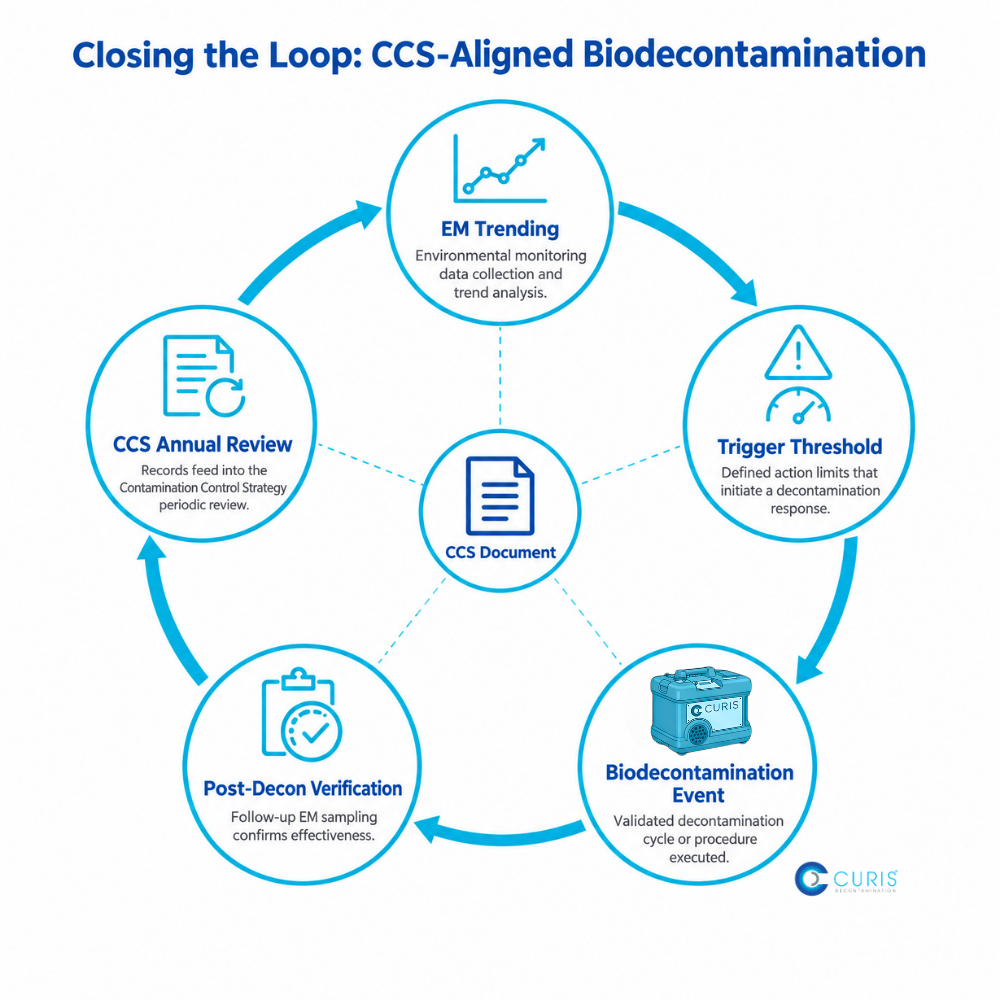
Aligning your biodecontamination program with your CCS does not require replacing your equipment or rewriting your quality system. It requires connecting a few things most facilities already have in isolation—matched to whichever method or combination of methods you run:
- Validation practices matched to your method. Annex 1 asks you to validate how you actually disinfect.
- Fumigation Validation: As a best practice, many facilities validate automated fumigation or vapor-phase cycles in the actual spaces where they'll run—including worst-case locations identified in their facility risk assessment—using biological indicators at challenge points (behind equipment, inside pass-throughs, at HVAC returns) to confirm sporicidal kill under real operating conditions—often conducting 3rd-party Disinfection Efficacy Testing (DET).
- Manual Disinfection Validation: For manual sporicidal disinfectants, the equivalent practice is documented technique and coverage verification, plus EM correlation, confirming labeled contact time and dilution are actually being achieved on the floor. Either way, the goal is the same: evidence that ties the product's claim to your own conditions.
- Automated parameters where you run cycle-based systems. Where your CCS calls for fumigation, removing operator variability from the cycle matters: systems that run pre-programmed parameters—fixed concentration, exposure time, and aeration—deliver the same validated result every time and automatically generate immutable data documentation. That consistency is what makes a cycle-based step easy to defend at audit.
- EM-triggered response protocols. Define in your CCS what EM results trigger a biodecontamination event. For example: any Grade A/B excursion above the action limit initiates a decontamination response within 24 hours, followed by repeat EM sampling. Documented as a procedure rather than a judgment call, this closes the loop between monitoring and response.
- Records that feed your annual CCS review. Every biodecontamination event—a fumigation cycle or a scheduled manual disinfection round—should produce a record appropriate to its method, and that record should roll into your CCS periodic review. Trending this data over time is what demonstrates your contamination controls are not just defined, but effective.
Where Automated Fumigation Fits
Used after manual wipedown—removal of particulates—automated, hydrogen peroxide-based fumigation adds consistency at the room level: the same cycle, the same parameters, and cycle data captured automatically, without depending on operator technique to hit the label claim on a given pass.
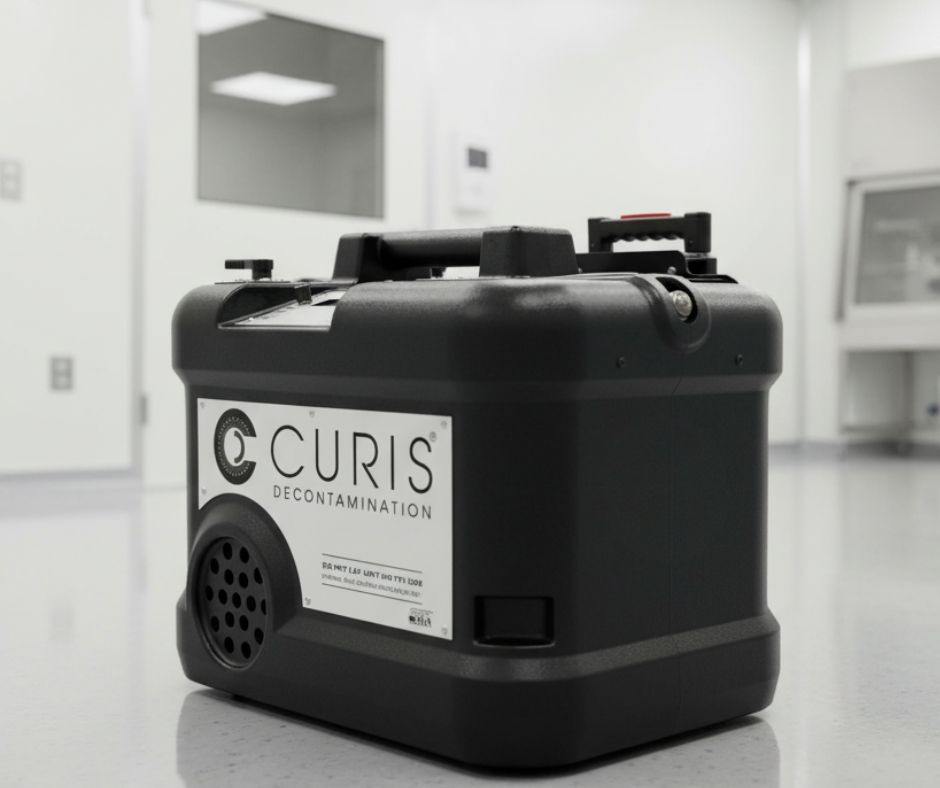 Systems like CURIS® Hybrid Hydrogen Peroxide™ (HHP™) generators run automated cycles with pre-set parameters, log cycle data as they run, and meet the EPA's ≥6-log sporicidal standard as a condition of that label—giving you a documented, repeatable starting point for the facility-specific validation Annex 1 expects. Compared with legacy fumigation chemistries such as formaldehyde or chlorine dioxide, hydrogen peroxide systems also avoid the toxicity handling and material-compatibility documentation those agents carry. Unlike other low-concentration systems, CURIS’ 7% HHP™ technology doesn’t pose hazards due to electric arcs or leave silver residues which may require manual removal.
For facilities updating their CCS to reflect actual practice, repeatability is what makes the fumigation step easier to validate, schedule, and defend at audit.
Key Takeaways
- Annex 1 treats biodecontamination as a validated process, not a cleaning task; your CCS needs to show validated efficacy.
- The most common audit finding is a gap between what the CCS document describes and how biodecontamination is actually performed and documented.
- Closing that gap means validating each method the way it's typically substantiated in practice—cycle qualification for automated fumigation, technique and coverage verification for manual disinfection—plus EM-triggered response protocols and records that feed your annual CCS review.
- Automated fumigation systems with built-in cycle documentation make consistent, audit-ready CCS alignment easier to sustain alongside your existing disinfection program.
Frequently Asked Questions
Does Annex 1 require a specific biodecontamination method?
No. Annex 1 is method-agnostic—it requires that whatever method you use, manual disinfection, automated fumigation, or both, is validated for your actual use conditions, documented, and integrated into your Contamination Control Strategy. The regulation itself does not specify a numeric log-reduction requirement. A ≥6-log reduction of bacterial spores is the EPA's required standard for a product to be labeled sporicidal—that's an EPA bar, not an Annex 1 one—but important to know when selecting a sporicidal disinfectant.
How often should cleanrooms be biodecontaminated under Annex 1?
Annex 1 does not prescribe a fixed frequency. Your CCS should define biodecontamination schedules based on your facility’s risk assessment, classification, and environmental monitoring data. Most facilities schedule routine cycles or rounds monthly or quarterly, with additional event-driven activity triggered by EM excursions. Many with high throughput have moved toward weekly.
What documentation does Annex 1 expect for biodecontamination?
Annex 1 doesn't itemize a checklist—it expects a documented record of what you did and evidence it worked. In practice, that commonly includes, for automated cycles: agent EPA-registration status, exposure duration, environmental conditions, and biological indicator results; for manual application: product EPA registration status, dilution, contact time, and technique verification. Either way, records should be available for inspection and should feed into your annual CCS review as evidence that your contamination controls are effective.
How does biodecontamination relate to environmental monitoring under Annex 1?
Your EM program and biodecontamination program should be linked in your CCS. EM trending data should inform decontamination scheduling, and post-decontamination EM sampling should verify effectiveness. Annex 1 expects this connection to be documented as a procedure, not left to operator judgment.
If your CCS references biodecontamination but your validation, scheduling, or documentation doesn’t yet support what the document says, that’s the gap to close. Talk to our team about how hydrogen peroxide biodecontamination systems align with your Annex 1 requirements alongside the disinfection program you already run.
Related: Is Your Facility Up to Date with New Annex 1 CCS Guidance? (March 2023)