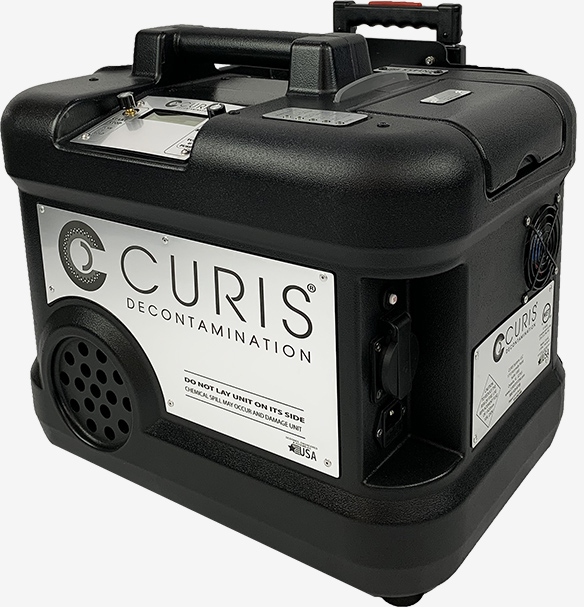
| Consistent Execution |
Measured Reentry |
| The cycle runs the same way at 2 p.m. Tuesday and 3 a.m. Sunday—which is what makes your environmental monitoring trends interpretable. |
The room is released on measured concentration against your threshold, not on a timer set conservatively years ago. |
| Records that Write Themselves |
Staff Off the Critical Path |
| Cycle documentation is generated, not transcribed—less risk under cGMP and EU GMP Annex 1. |
Nobody closes dampers, watches a clock, or stands at a door with a handheld meter. |
Two ways to get there (CURIS BMS Link System™ or CURIS Totalis™). The difference is whether your equipment stays portable, or decontamination becomes part of the building.
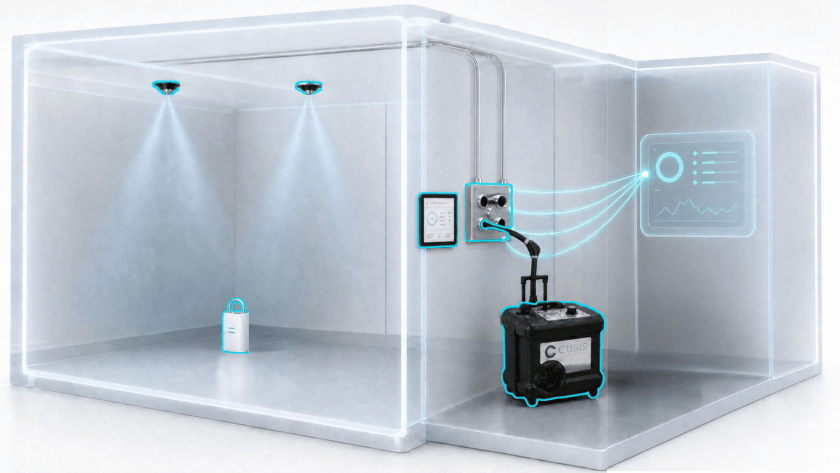 Automated Room Decon. Portable Equipment. Automated Room Decon. Portable Equipment.
CURIS BMS Link System™
Where portability meets integration.
Connect your CURIS 3 units to your BMS for fast and easy automated, repeatable decontamination of one or more fixed rooms, chambers, or airlocks. Installed, validated, and supported by CURIS.
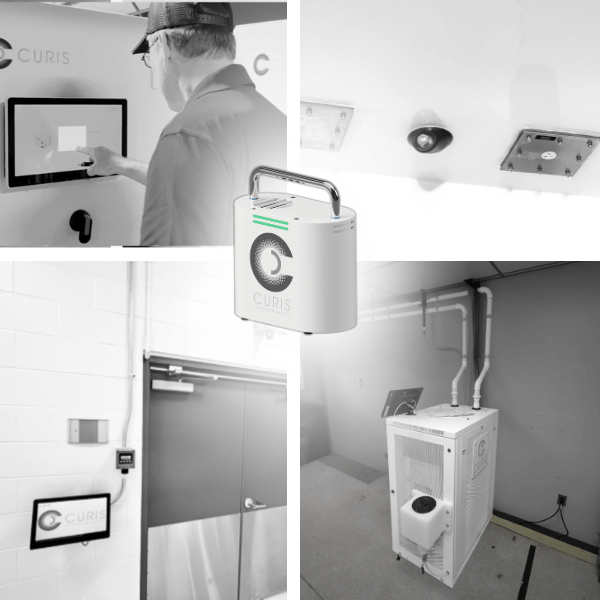
Your decontamination equipment never enters the room. The CURIS 3 units stay in the corridor and connect at a wall-mounted panel. Nothing is wheeled into the treated space, and nothing needs to be retrieved afterward.
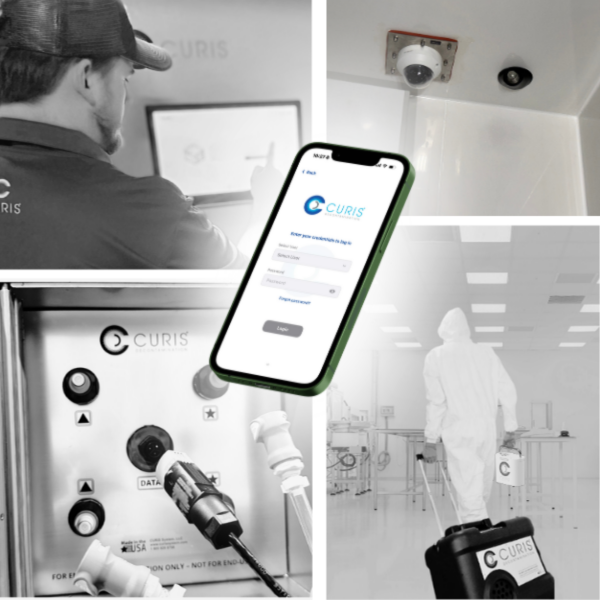
Reentry on a measurement, not a countdown. A portable sensor placed anywhere in the space monitors throughout the cycle and signals when your predetermined reentry threshold is reached. No handheld meter at the door. No conservative timer costing you the room every night.
Communication with your BMS to drive operations. Triggers automated functions at key points of the cycle.
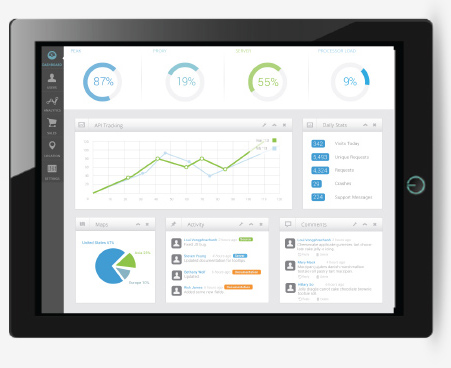
Touchscreen operation. Pre-programmed cycles. Operators select the validated cycle at the wall panel—it's chosen, not configured. Real-time data and reporting produces the cycle record for your quality and risk management teams without anyone transcribing it.
Installation, commissioning, cycle validation, and training. Deploy one system per room, from a single suite to whatever scale you need.
Available now—in use across pharmaceutical manufacturing, biotech, and biosafety facilities. Request a BMS Link System™ consultation.
Permanent infrastructure. No decontamination equipment handling.
CURIS TOTALIS™
Decontamination built into the facility.
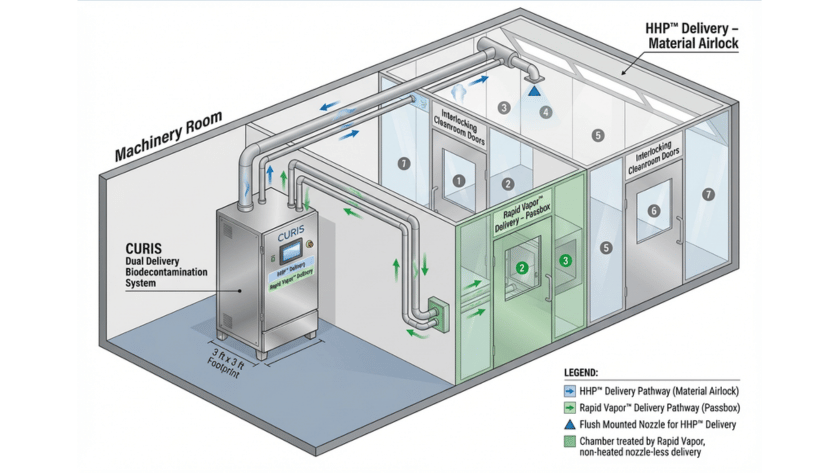
A biodecontamination system engineered specifically for your facility. Vapor distribution, monitoring, and control are permanent infrastructure—no portable units staged in or out of the space.
Engineered to your facility, not to a catalog. Space volumes, air handling, cycle sequences, and control logic are specified around your requirements and your validation program rather than fitted to a standard component set.
No CURIS 3 units required. Biodecontamination is built into the system. Nothing is wheeled to the room, connected, disconnected, or stored between cycles.
Built to run multiple spaces as one program. Suites, multi-room sequences, and facility-wide coverage are coordinated together rather than as independent rooms each running their own cycle.
A CURIS-managed project, start to finish. Design qualification, fabrication, installation, commissioning, cycle development, validation support, and training.
 When Totalis™ is the right answer... When Totalis™ is the right answer...
- Autonomous operation: permanently installed biodecontamination, with no portable units staged in or out
- Multi-room sequences run as a single coordinated program
- New construction or major renovation, where the architecture can be designed in from the start
Talk to an integration engineer about Totalis™.
Integration with Facility Infrastructure
Depending on the integration level, CURIS systems can interact with:
- Building automation systems (BAS/BMS)
- HVAC and air handling systems
- Door interlocks and access controls
- Environmental monitoring systems
- Reporting and compliance platforms
This allows facilities to align biodecontamination with operational workflows and safety requirements.
Material Airlocks and Transfer into Cleanroom Space
Every item crossing the grade boundary is a judgment call someone is making by hand.
The airlock is often where a contamination control program stops being engineered and starts being manual. Components, tooling, totes, carts, and outer packaging arrive at the pass-through, and an operator wipes them down—surface by surface, item by item. With wipe-down disinfection, application varies by operator, and no validation occurs.
Integrating biodecontamination into the airlock changes ensures:
A validated cycle, not a wipe-down procedure. Hybrid Hydrogen Peroxide™ (HHP™) technology delivers low-concentration (7%) hydrogen peroxide vapor throughout the chamber, reaching the underside of a tote and the seams of a case the same way it reaches the top surface. The cycle runs identically for the first pallet of the shift and the last one.
The doors stay locked until the cycle says otherwise. Cycle settings are hardwired to the airlock interlock and the transfer cannot be short-cut on a busy shift—not because of a rule, because of a lock.
Reentry on measurement, not a countdown. The chamber is released against your predetermined threshold, monitored throughout the cycle. No operator standing at the door with a handheld meter, and no timer padded years ago that costs you fifteen minutes on every transfer.
A record per transfer, generated rather than transcribed. Each cycle produces its own documentation for your quality and risk management teams—easier to hand an auditor than a wipe-down logbook.
No harmful residues on what you just transferred. Low-concentration (7%) hydrogen peroxide vapor breaks down into water vapor and oxygen, so sensitive components, electronics, and packaging don't carry a disinfectant film into your clean space.
Room Decontamination for Biosafety Laboratories and Vivariums
Biosafety and vivarium environments often require room-level biodecontamination to protect personnel, research integrity, and animal health.
Integrated systems support:
- Whole-room decontamination cycles
- Equipment and chamber decontamination
- Coordinated workflows with safety systems
By delivering vapor through controlled methods and supporting repeatable cycles, CURIS systems help maintain consistent contamination control procedures to assist in protecting against risk group pathogens and reduce human error.
Flexible Integration for Real-World Facilities
Every facility operates differently—some prioritize portability and flexibility, others require automation and centralized control. Some environments also need multiple transfer strategies, separate workflows for sensitive materials, or coordination with existing facility classifications. The CURIS BMS Link System™ and Totalis™ accommodate these variations through flexible configurations with the right level of integration—without overengineering or oversimplifying the solution.
Frequently Asked Questions
What is an integrated biodecontamination system?
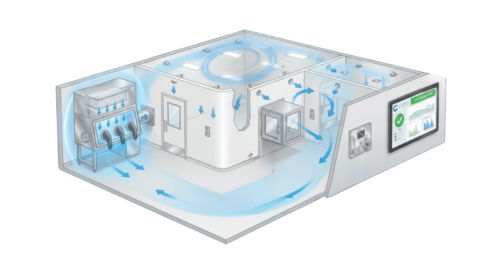
A system that delivers vaporized hydrogen peroxide in a controlled, repeatable manner, often integrated with facility infrastructure.
What is the difference between portable and integrated systems?
Portable systems operate independently within a room, while integrated systems coordinate with facility systems or use fixed infrastructure, such as wall or ceiling mounted nozzles, for improved consistency and automation.
Can CURIS systems integrate with building automation systems?
Yes. Depending on the system level, CURIS solutions can communicate with or control BAS/BMS systems, HVAC, and facility controls.
Do all systems require fixed installation?
No. The CURIS BMS Link System™ is portable-powered or docked in place, while Totalis™ is fully fixed.
What is VPHP (vaporized hydrogen peroxide)?
VPHP, or vaporized/vapor-phase hydrogen peroxide, is hydrogen peroxide dispersed as a vapor to decontaminate rooms, chambers, and equipment. CURIS uses Hybrid Hydrogen Peroxide™ (HHP™) technology to deliver low-concentration (7%) hydrogen peroxide vapor with no harmful residues.
What is the difference between CURIS BMS Link System™ and Totalis™?
The CURIS BMS Link System™ provides coordinated integration with minimal infrastructure and Totalis™ delivers fully automated, facility-wide biodecontamination built into building infrastructure.
Which industries use integrated hydrogen peroxide biodecontamination?
Pharmaceutical cleanrooms, biotechnology and cell and gene therapy, barrier facilities, biosafety laboratories (BSL-2 to BSL-4), vivariums, and containment research facilities.
Can the CURIS BMS Link System™ cover more than one room?
Yes. You can use one or more CURIS 3s for multiple treatment spaces, consecutively. A project currently in progress covers more than ten rooms.
Can we run cycles without the BMS?
Yes. Cycles start from the CURIS 3, a touchscreen HMI, or the CURIS Decon App independently.
Does using CURIS replace cleaning completely?
No. Cleaning of particulates remains foundational with any fumigation system. Integrated vaporized hydrogen peroxide (VPHP) biodecontamination makes the result repeatable and documented.
Does CURIS have chamber or material airlock (MAL)-specific biodecontamination options?
Yes. For more information on our chamber options, please visit our product page: CURIS Chamber Integrations.
Request an Integration Assessment
Send us the space volume and what your building management system controls today. A CURIS integration engineer will confirm whether the BMS Link System™ fits—and tell you plainly if it does not.
👉 Talk to a CURIS Integration Specialist
|
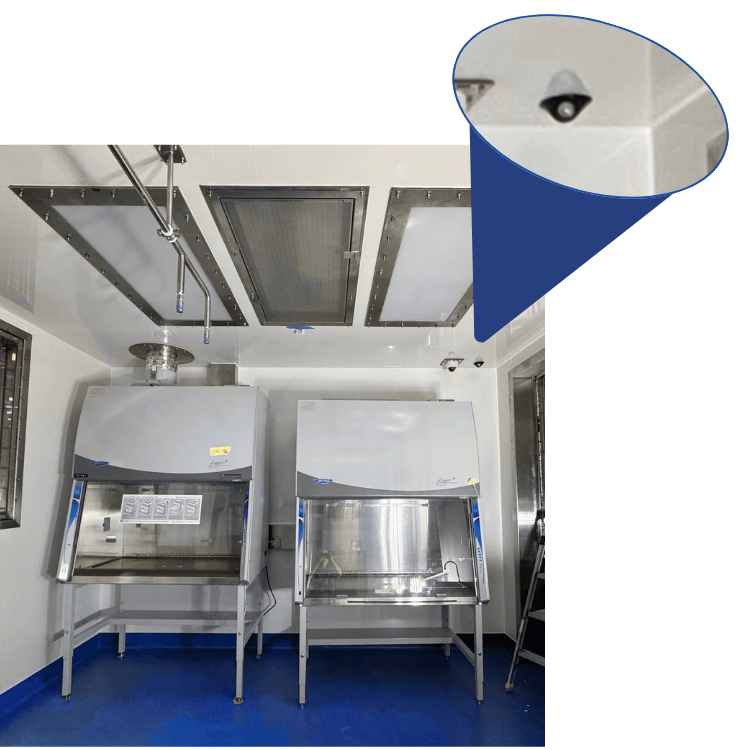 What is an Integrated Biodecontamination System?