IVC Rack Decontamination: How Hidden Pathogens Survive—and How to Stop Them
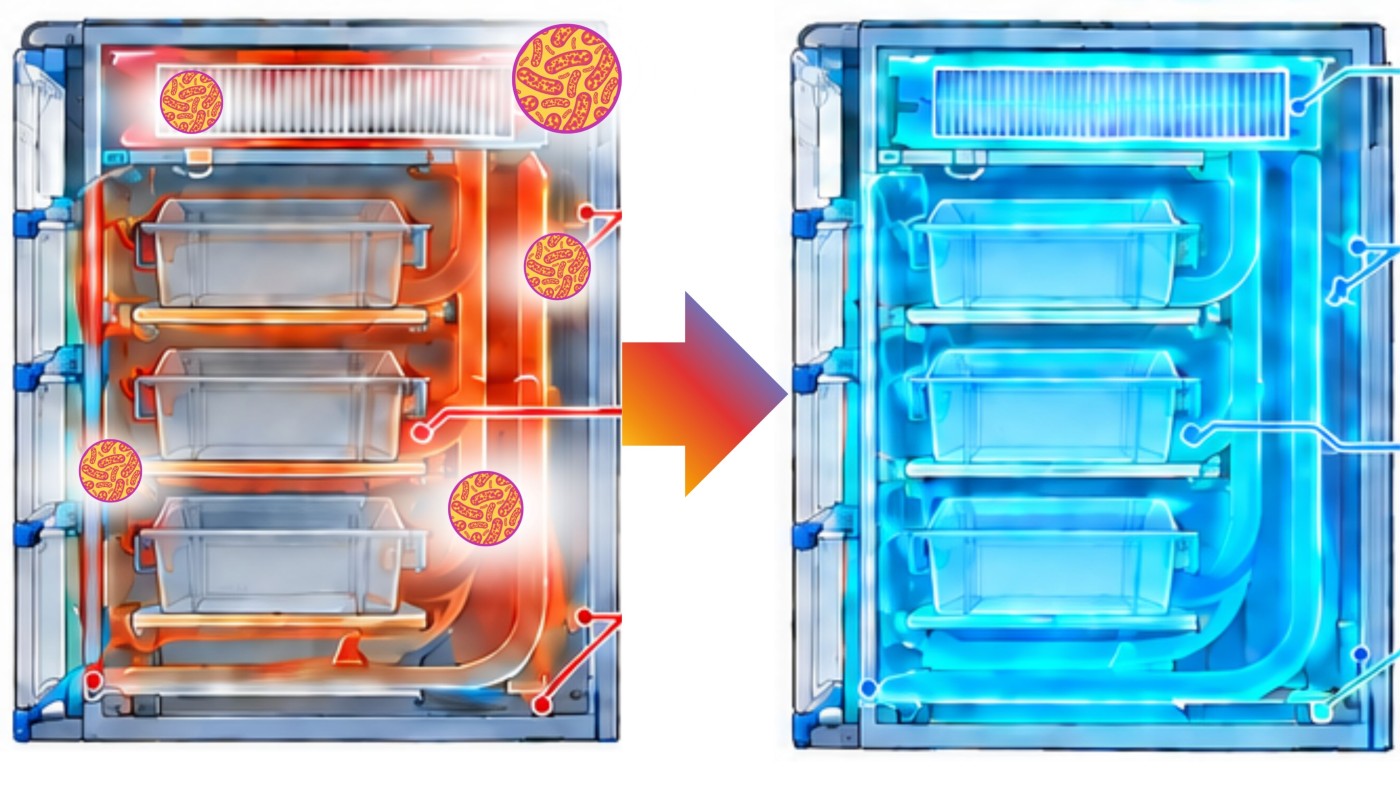
How automated hydrogen peroxide decontamination closes the gaps manual methods leave behind
Key Takeaways
- Your IVC racks may be carrying a microbial burden even when your facility looks clean: published surveillance data found pathogens more readily inside rack exhaust plenums than in the animals themselves
- Manual disinfection and static VHP treatment leave critical gaps—peer-reviewed case studies document PCR-positive equipment airways even after vaporized hydrogen peroxide treatment on open, disassembled equipment
- Automated decontamination with Hybrid Hydrogen Peroxide™ (HHP™) technology achieves 6-log sporicidal reduction, even into cages and through IVC filters/plenums
- Facilities that integrate scheduled automated decontamination into routine operations—rather than deploying it only after an outbreak—consistently report longer pathogen-free intervals and faster EH&S buy-in, particularly with Hybrid Hydrogen Peroxide™ technology's lower-concentration profile
Picture this:
A vivarium manager gets the call no one wants. PCR results from the quarterly health surveillance are back, and Pasteurella pneumotropica has turned up in three rooms across two barrier suites. Within days, immunodeficient colonies that took months to establish are quarantined. Irreplaceable transgenic lines face rederivation—or worse, euthanasia. Researchers scramble to assess which study data can still be trusted.
It is a scenario that plays out more often than our industry likes to admit. Facility-acquired infections remain one of the most disruptive—and most preventable—risks in laboratory animal science. The question is not whether your facility will face a biosecurity challenge, but whether your decontamination program is built to catch it before it cascades.
Where Do Pathogens Hide in IVC Systems?
Modern vivaria are engineered for containment. Individually ventilated cage (IVC) systems, HEPA-filtered air handling, gowning protocols, and strict traffic flow all work together to keep colonies clean. But pathogens are opportunists, and the weak points are often the ones we overlook.
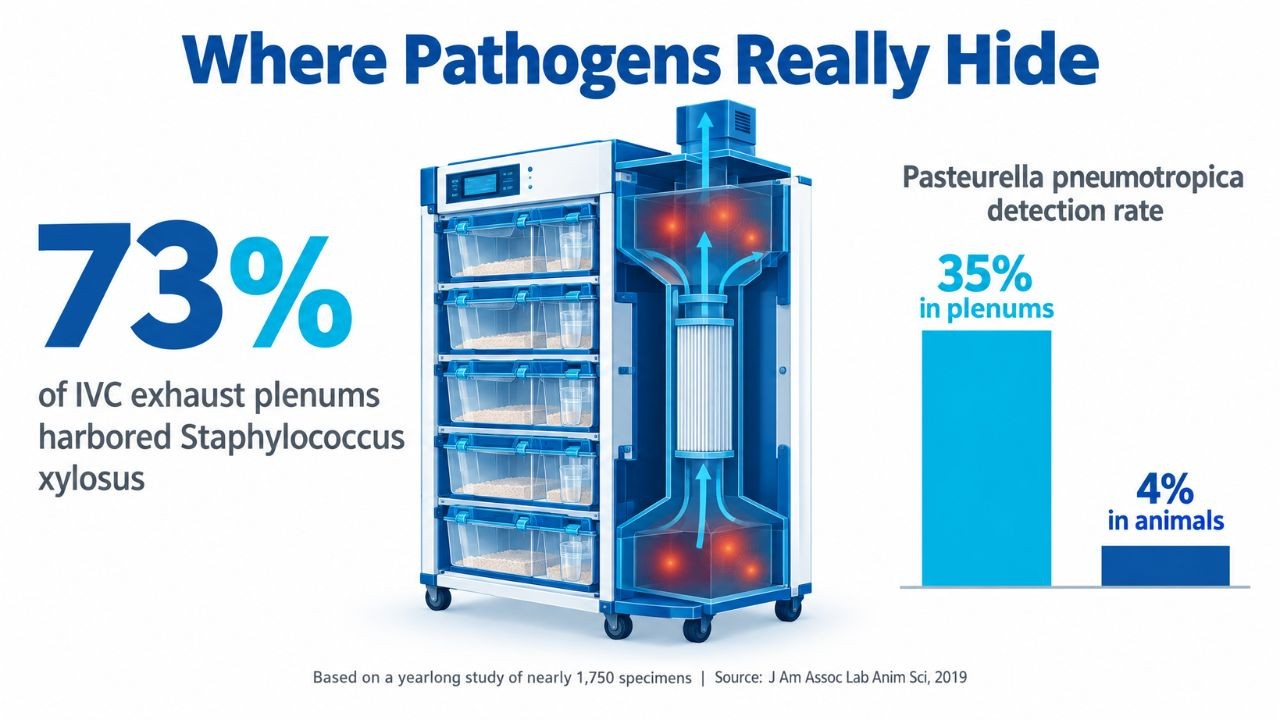 Published surveillance data tell a sobering story. In a yearlong study that tested nearly 1,750 specimens across murine and IVC equipment samples, researchers detected eight opportunistic microbes—and found that organisms were more readily detectable inside IVC exhaust plenums than in the animals themselves.1 Staphylococcus xylosus appeared in 73 percent of plenum specimens. Pasteurella pneumotropica biotype Heyl, an organism capable of causing pneumonia and abscesses in immunodeficient mice, was present in 35 percent of plenums despite appearing in only 4 percent of murine samples.1
The takeaway is clear: equipment airways and internal surfaces are silent reservoirs. Standard cage-change protocols and surface wipe-downs address what you can see and reach. They do not address what is harbored inside rack plenums, behind HEPA filters, and along the tortuous airflow paths of IVC systems. A facility can look clean on the surface while the infrastructure itself carries a microbial burden from room to room.
Why Manual Vivarium Decontamination Fails to Eliminate Pathogens
When an outbreak occurs, most facilities respond with a combination of manual surface disinfection, animal depopulation, and—in severe cases—facility shutdown. The peer-reviewed literature documents what this looks like in practice. In one widely cited case, a Corynebacterium bovis outbreak affected 35 percent of a facility’s housing space.2 All replaceable immunodeficient strains had to be euthanized. Irreplaceable lines were relocated to neighboring institutions for rederivation, a process that consumes months of time and significant resources.
Even the initial decontamination attempt in that case fell short. Researchers applied vaporized hydrogen peroxide to disassembled, open-configuration equipment—the standard approach at many facilities—and found that 12 percent of equipment airways remained PCR-positive afterward.2 The pathogen survived inside the very surfaces the treatment was supposed to reach.
Manual chemical disinfection faces similar limitations. Liquid disinfectants work on contact, which means they are effective only on surfaces they physically wet. The interior airways of an IVC rack, the underside of a cage-change station’s work surface, the gaps behind gaskets—these areas rarely see full chemical contact during a manual wipe-down. And because manual methods depend on individual technique, dwell time, and coverage, reproducibility from one decontamination event to the next is inherently variable.
How Automated Hydrogen Peroxide Decontamination Eliminates IVC Rack Pathogens
The breakthrough in the Corynebacterium bovis case came when the research team switched from a static, open-equipment protocol to an active, closed-configuration approach—running assembled IVC racks with their air-handling units operational during hydrogen peroxide treatment. The result was decisive: PCR-detectable evidence of C. bovis and all other tested microbes dropped to zero.2 The same approach proved effective against all eight opportunistic organisms identified in the companion surveillance study, achieving statistically significant superiority over static methods (P < 0.01).1
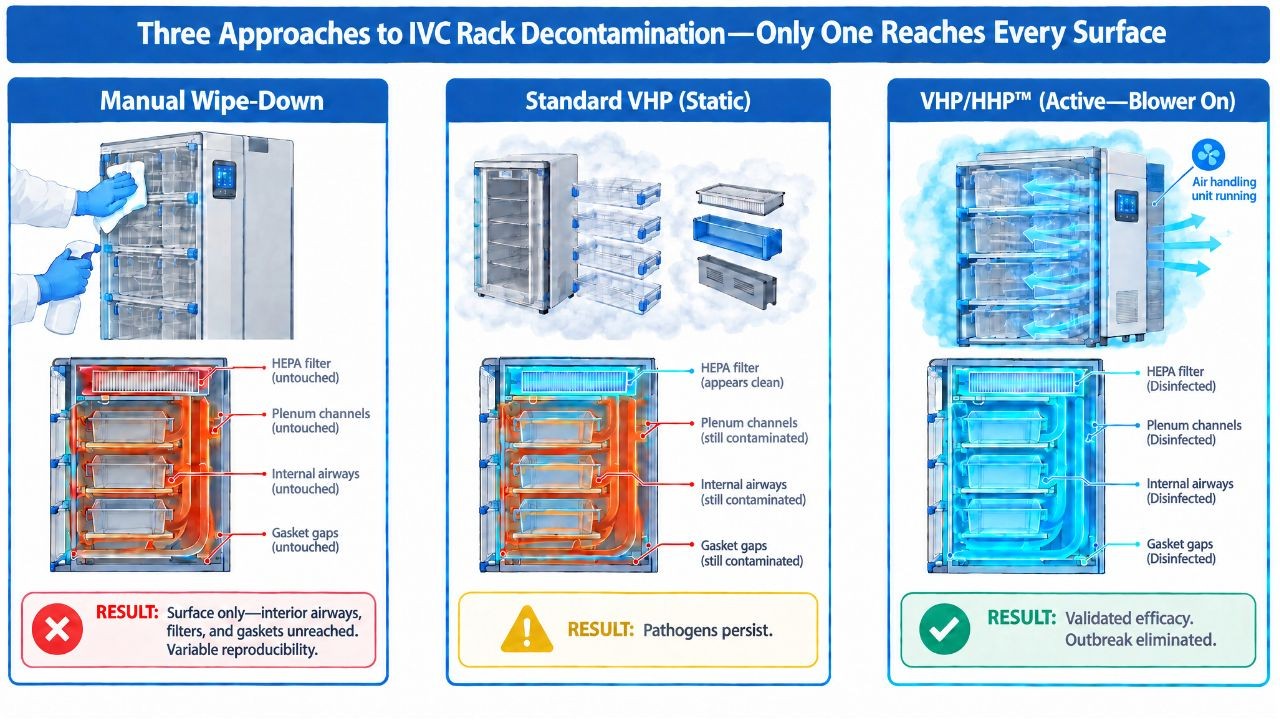 This is precisely the principle behind CURIS System’s Hybrid Hydrogen Peroxide (HHP™) technology. The CURIS approach delivers a 7% hydrogen peroxide formulation as both micro-aerosol and vapor to reach surfaces, penetrate equipment airways, and permeate HEPA filter media that liquid disinfectants and even some single-phase vapor systems cannot access. Independent testing has demonstrated greater than 6-log sporicidal reduction, including inside hard-to-reach spaces such as isolator glove assemblies and IVC exhaust filters.3
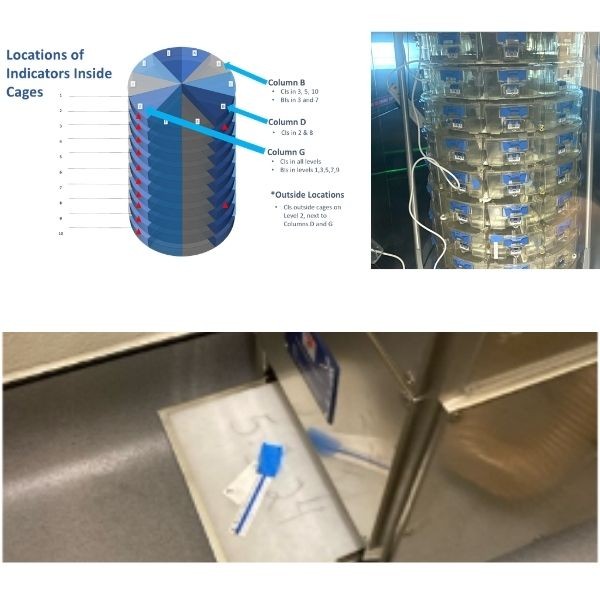
These capabilities have been validated in the field. Researchers at the University of Houston evaluated CURIS System's ability to decontaminate their IVC racks—including into cages and through filters—within a dedicated decontamination chamber, successfully achieving 6-log efficacy throughout, even after other hydrogen peroxide technologies could not. Separately, the New York State Department of Public Health evaluated Hybrid Hydrogen Peroxide™ (HHP™) decontamination of IVC racks as part of a three-room laboratory decontamination cycle.4,5 Both studies are available from CURIS System upon request.
For vivarium operations, the practical advantages extend beyond raw efficacy. The CURIS 3 portable system or CURIS’ BMS Link System™, with fixed nozzles, can be deployed room by room and controlled from outside the space without requiring a facility-wide shutdown, enabling targeted responses that keep unaffected colonies in production. Cycle data—including dwell time, operator identification, and system status—are captured automatically through the CURIS Decon App, providing the documentation trail that IACUC committees and accreditation bodies expect. Because HHP™ operates at a lower concentration than traditional high-concentration vaporized hydrogen peroxide systems (VHP), aeration and room recovery are up to 4.8 times faster, minimizing downtime that disrupts research timelines.3
Building a Preventive Vivarium Decontamination Program
The most effective vivarium biosecurity programs do not treat decontamination as a crisis response. They build it into the operational rhythm. Scheduled whole-room decontamination between study cohorts, prior to introducing immunocompromised animals to the space, and periodic facility-wide cycles all contribute to a layered defense that reduces the probability of an outbreak taking hold in the first place.
Facilities that have adopted this model report meaningful operational improvements. One study of a mid-Atlantic research institution integrated automated hydrogen peroxide decontamination into its quarterly maintenance schedule documents an 11-month period with zero pathogen recurrence—following an outbreak that had previously resisted months of manual intervention.2 The key was not a single heroic decontamination event but a sustained, validated program that addressed equipment interiors and room surfaces alike.
The pattern repeats across institutions using CURIS technology. Multiple vivarium programs that had struggled with persistent C. bovis contamination—cycling through manual disinfection protocols without achieving lasting eradication—have reported success after transitioning to automated HHP™ decontamination. Facility managers consistently highlight two factors beyond efficacy: the system is straightforward to implement within existing workflows, and the 7% hydrogen peroxide concentration with no silver additives earns faster buy-in from Risk Management and EH&S teams compared to higher-concentration alternatives. When the method that actually works is also the one your safety officer prefers, adoption accelerates.
For animal lab science professionals weighing their options, the calculus is straightforward. The cost of a single colony loss event—disrupted studies, rederivation timelines, facility downtime—dwarfs the investment in a decontamination program that prevents it.
If your facility’s current approach relies on manual methods alone, or if you have experienced the disruption of a facility-acquired infection, it may be time to evaluate what automated decontamination can do for your program. Talk to the CURIS team about how HHP™ technology integrates into vivarium workflows—from single-room response to facility-wide biosecurity programs. See how CURIS 3 works in your facility.
FAQ
Q: What pathogens are commonly found inside IVC rack exhaust plenums?
A: Published surveillance data have identified multiple opportunistic organisms inside IVC exhaust plenums, including Staphylococcus xylosus (detected in 73% of plenum samples in one study), Pasteurella pneumotropica, and six additional murine pathogens. These organisms were detected at higher rates inside rack plenums than in animal specimens from the same facility, highlighting equipment interiors as a critical—and often overlooked—reservoir.
Q: Why does manual disinfection fail to eliminate pathogens inside IVC racks?
A: Liquid disinfectants work on contact and cannot reach the internal airways, exhaust plenums, and HEPA filter media inside an assembled IVC rack. Manual methods also depend on individual technique and coverage, which introduces variability from one decontamination event to the next. Peer-reviewed case studies have documented PCR-positive equipment airways even after manual and single-phase vapor treatment.
Q: What is HHP™ decontamination, and how is it different from standard VHP?
A: Hybrid Hydrogen Peroxide™ (HHP™) technology delivers a 7% hydrogen peroxide formulation as both micro-aerosol and vapor simultaneously, enabling penetration into equipment airways, HEPA filter media, and porous surfaces. At 7% concentration, aeration times are up to 4.8 times faster than traditional high-concentration vaporized hydrogen peroxide (VHP) systems in independent testing—reducing room downtime and supporting integration into routine operational schedules.
Q: How does automated hydrogen peroxide decontamination support IACUC and accreditation documentation?
A: The CURIS® Decon App captures cycle data automatically, including dwell time, operator identification, and system status. This creates a consistent, time-stamped documentation trail that supports IACUC reporting, institutional biosafety reviews, and AAALAC accreditation requirements without relying on manual log entries.
Q: Can hydrogen peroxide decontamination be used preventively, or only after an outbreak?
A: Automated hydrogen peroxide decontamination is well-suited to preventive use. Facilities that have integrated scheduled whole-room and IVC rack decontamination into quarterly maintenance cycles have documented extended outbreak-free periods following prior persistent contamination. Preventive programs reduce the probability of a pathogen establishing a foothold, lower the cost of outbreak response, and align with 3Rs principles by reducing the number of animals affected by facility-acquired infections.
References
- Roble GS, Bhatt SV, Golas GR, et al. PCR prevalence of murine opportunistic microbes and their mitigation by using vaporized hydrogen peroxide. J Am Assoc Lab Anim Sci. 2019;58(2):208–215. https://pmc.ncbi.nlm.nih.gov/articles/PMC6433363/
- Roble GS, Orajay VE, Engel CE, et al. Facility-wide eradication of Corynebacterium bovis by using PCR-validated vaporized hydrogen peroxide. J Am Assoc Lab Anim Sci. 2018;57(5):551–560. https://pmc.ncbi.nlm.nih.gov/articles/PMC6159683/
- CURIS System. HHP™ technology performance data. https://curissystem.com/products
- University of Houston. Biodecontamination of an IVC Rack Using Automated, Integrated HHP Decontamination. Study available from CURIS System upon request.
- New York State Department of Public Health. Modernizing Bio-Decontamination: NY Public Health’s Successful Evaluation of a Portable VPHP System. Study available from CURIS System upon request.