What to Do When Your Cleanroom Fails an Environmental Monitoring Test
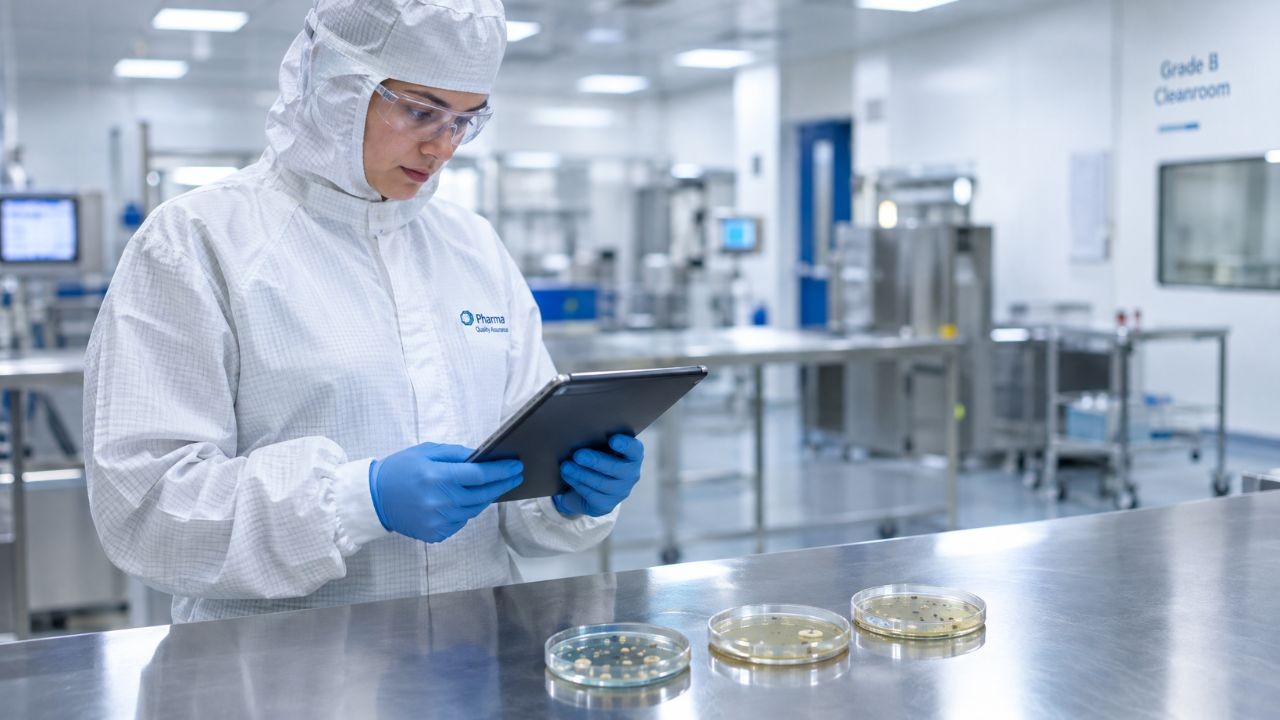
- An environmental monitoring (EM) excursion is not a crisis—it is a signal. How you investigate and respond determines whether the event becomes a footnote or a regulatory finding.
- Every excursion above your action limit requires a documented investigation, root cause analysis, and corrective action—regardless of whether product was exposed.
- Facilities that treat EM failures as one-off events instead of system indicators tend to see repeat excursions, escalating regulatory scrutiny, and costly remediation.
- Whole-room biodecontamination with hydrogen peroxide is one tool in a broader corrective toolkit—used when contamination has spread beyond what manual disinfection can reliably address.
You get the plate results back, and the numbers are above your action limit. The cleanroom that passed monitoring last week is now showing elevated microbial counts. What happens next matters more than the result itself.
Environmental monitoring excursions are a routine reality in pharmaceutical and biopharmaceutical manufacturing. Even well-maintained facilities encounter them—after maintenance shutdowns, personnel changes, HVAC service, or simply because contamination is persistent and opportunistic. The question is never whether your facility will see an EM failure. The question is whether your response is fast enough, thorough enough, and documented well enough to satisfy both your quality system and your regulators.
This guide walks through the investigation and corrective action process that pharma and biopharma QA teams need to follow when an EM test comes back out of specification—from the first 24 hours through root cause analysis, corrective action, and return to normal operations.
What Counts as an EM Failure?
Before diving into response protocols, it helps to clarify the terminology. Environmental monitoring programs define two thresholds for microbial and particulate results:
-
Alert Limits
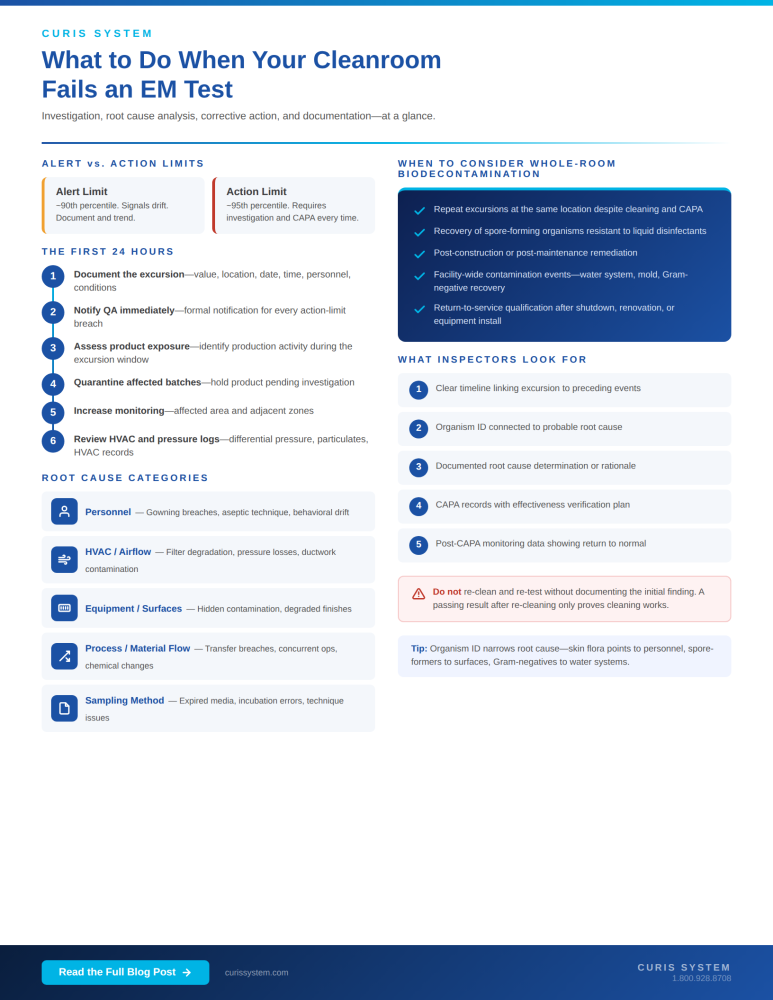
- are set at approximately the 90th percentile of your facility’s historical data. Exceeding an alert limit signals a potential drift from normal conditions. It requires documentation and trend review, but does not typically trigger a formal investigation on its own.
-
Action Limits
- are set at approximately the 95th percentile, below regulatory specification limits. Exceeding an action limit requires immediate investigation and corrective action—every time, regardless of whether product was in the room.
Consecutive alert-level results at the same location can be just as significant as a single action-limit breach. Trending is critical: three consecutive alert-level readings at a Grade B workstation, for example, should trigger the same level of scrutiny as a single action-limit excursion.
EU GMP Annex 1 reinforces this: environmental monitoring data must be trended and fed back into process controls as part of your contamination control strategy (CCS). Investigation and CAPA are not optional follow-ups—they are integral CCS elements.
What Should You Do in the First 24 Hours?
The initial response to an action-limit breach sets the tone for everything that follows. Speed and documentation are equally important.
Immediate Response Checklist
- Document the excursion: exact value, sample location, date, time, sampling personnel, and environmental conditions (temperature, humidity, differential pressure at time of sampling).
- Notify Quality Assurance immediately for any action-limit breach.
- Identify what production activity was occurring during the excursion window and whether product was exposed.
- Quarantine potentially affected batches pending investigation outcome.
- Increase monitoring frequency in the affected area and adjacent zones—this additional data informs the scope of your investigation.
- Review the most recent HVAC, differential pressure, and particulate monitoring logs for the affected room.
What Not to Do
Avoid the instinct to immediately re-clean and re-test without documenting the initial finding. A passing result after re-cleaning does not close out the excursion—it simply demonstrates that cleaning works. The investigation still needs to determine why the excursion occurred.
How Do You Conduct a Root Cause Investigation?
Root cause analysis for an EM excursion should follow a structured framework, not a best guess. Most excursions fall into a handful of categories, and each one points to a different corrective action.
Common Root Cause Categories
|
Root Cause |
Common Indicators |
Typical Corrective Action |
|
Personnel |
Gowning breaches, improper aseptic technique, training gaps, behavioral drift over time |
Retraining, requalification, behavioral coaching; escalate if same personnel appear in multiple investigations |
|
HVAC / Airflow |
Filter degradation, pressure differential losses, supply air volume changes, ductwork contamination after maintenance |
Filter replacement, pressure rebalancing, ductwork inspection; VHP decontamination after panel or interstitial access |
|
Equipment / Surfaces |
Residual contamination behind panels, under raised flooring, inside conduit penetrations; degraded surface finishes harboring biofilm |
Enhanced manual cleaning; whole-room H₂O₂ biodecontamination for inaccessible areas |
|
Process / Material Flow |
Material transfer breaches, concurrent operations introducing contamination vectors, changes to cleaning chemical concentration or contact time |
Procedure tightening, cleaning chemical requalification, concurrent operation controls |
|
Sampling Method |
Expired or improperly stored media, incorrect incubation, sampling technique errors, transport contamination |
Media management review, technique retraining, transport validation; rule out false positives first |
Organism identification to genus and species level is important for viable excursions. The identity of the organism often narrows the root cause considerably—skin flora points toward personnel, environmental spore-formers point toward surfaces or construction, and Gram-negative organisms may indicate water system issues.
What Corrective Actions Actually Work?
The corrective action should be proportional to the root cause and to the scope of the contamination. Not every excursion requires the same response.
Personnel-Related Findings
Retraining and requalification on gowning, aseptic technique, or cleanroom behavior. If the same personnel appear in multiple excursion investigations, that pattern needs to be escalated beyond routine retraining—it may indicate a procedural gap rather than an individual performance issue.
HVAC and Infrastructure
Filter replacement, pressure rebalancing, or ductwork inspection. Following any maintenance that requires opening cleanroom panels or accessing sealed interstitial spaces, the room should be treated as potentially compromised. Research published in BioProcess International found that when vaporized hydrogen peroxide (VHP) decontamination was performed after maintenance shutdowns, microbial surface counts consistently reduced or remained stable, compared to periods when decontamination was omitted, where counts remained elevated or increased.
Surface and Equipment Contamination
When contamination has moved beyond accessible surfaces—behind wall panels, inside equipment housings, in areas that manual cleaning cannot consistently reach—whole-room biodecontamination with hydrogen peroxide offers something manual disinfection does not: uniform distribution to every exposed surface, including hidden and hard-to-access areas, with a documented cycle log confirming concentration, contact time, and aeration. Read more about it in our blog, "Rethinking Triple Clean."
This is not a replacement for your manual cleaning program. Wipe-downs address gross contamination and helps maintain baseline conditions shift to shift. Whole-room hydrogen peroxide biodecontamination is an enhancement that addresses the limitations of manual methods: the places wiping misses or cannot reach, variation between technicians, and possible documentation gaps between what was specified and what was actually done.
Process Changes
Review and tighten material transfer procedures, cleaning chemical qualifications, and concurrent operation controls. Document any process change as part of your CAPA record and verify effectiveness through post-implementation monitoring.
How Should You Document and Close the Investigation?
Regulatory inspectors evaluate EM excursion responses by the quality of the documentation, not just the outcome. Every investigation should produce:
- A clear timeline linking the excursion to preceding events (maintenance, personnel changes, process deviations).
- Organism identification results with a rationale connecting the organism type to the probable root cause.
- A documented root cause determination—or, if the root cause cannot be definitively identified, a documented rationale explaining the investigation’s conclusions and the basis for the chosen corrective action.
- CAPA records with specific, measurable corrective actions and a defined effectiveness verification plan.
- Post-corrective-action monitoring data demonstrating return to normal performance.
Cross-reference investigation records with batch disposition decisions. If product was in the room during the excursion window, the batch record should document the risk assessment and disposition rationale.
EU GMP Annex 1 expects that all excursions receive investigation regardless of product impact, and that trending data feeds back into your contamination control strategy. A pattern of well-documented investigations and effective CAPAs is one of the strongest indicators of a mature quality system during regulatory inspection.
 When Should You Consider Whole-Room Biodecontamination?
Not every EM excursion calls for a room-level hydrogen peroxide treatment. The checklist below identifies the situations where it adds value beyond what your existing manual disinfection program can deliver.
Consider whole-room biodecontamination if any of the following apply:
✓ Repeat excursions at the same location despite cleaning and CAPA completion—suggesting a reservoir the manual program is not reaching.
✓ Recovery of spore-forming organisms from surface samples—spores are resistant to many liquid disinfectants and persist in crevices, joints, and unsealed surfaces.
✓ Post-construction or post-maintenance remediation—any event that exposes interstitial spaces, ductwork, or sealed panels introduces organisms not previously accessible to routine cleaning.
✓ Facility-wide contamination events—a water system excursion, a mold outbreak, or a widespread Gram-negative recovery across multiple rooms.
✓ Return-to-service qualification—bringing a cleanroom back online after extended shutdown, renovation, or equipment installation.
In these scenarios, a portable hydrogen peroxide generator—such as the CURIS® system using Hybrid Hydrogen Peroxide™ (HHP™) technology—delivers a low-concentration (7%) hydrogen peroxide sporicidal vapor that distributes throughout the sealed room, reaching surfaces that wiping and spraying cannot. The automated cycle provides a documented record of concentration, exposure time, and aeration, which supports your CAPA file with objective evidence that the entire room was treated.
How Do You Prevent the Next Excursion?
Prevention is where awareness-stage content meets operational reality. The facilities with the fewest repeat excursions tend to share a few practices:
- Trending, not just reacting. Review EM data weekly by location and shift. Identify gradual upward trends before they hit action limits.
- Scheduled biodecontamination cycles. Some facilities add periodic hydrogen peroxide room treatments to their cleaning SOP—weekly, monthly, or quarterly, after every maintenance shutdown, or whenever trend data shows a sustained shift. This converts biodecontamination from a reactive remediation tool to a proactive contamination prevention measure.
- Organism library development. Track organism identifications over time to build a facility-specific “normal flora” baseline. Novel organisms or shifts in population composition are early warning signals.
- CCS feedback loops. Every investigation should ask whether the contamination control strategy itself needs updating—not just whether this specific event was resolved. Changes to monitoring locations, frequency, cleaning agents, or gowning procedures should flow back into the CCS document.
- Environmental Monitoring Program Qualification (EMPQ). If repeat excursions or systemic contamination events suggest that your monitoring locations, sampling frequencies, or alert and action limits no longer reflect the facility’s actual risk profile, it may be time to requalify the EM program itself. EMPQ is the formal process for reassessing whether your monitoring strategy is still fit for purpose—accounting for changes in room usage, equipment, personnel volume, and process flow since the program was originally qualified.
Frequently Asked Questions
Do I need to investigate every EM excursion, even if no product was in the room?
Yes. EU GMP Annex 1 and FDA expectations both require investigation of all action-limit excursions regardless of product exposure. The investigation scope may be narrower if product impact can be ruled out, but the event still requires a documented root cause determination and corrective action.
How quickly does an EM excursion need to be investigated?
Best practice is to begin the investigation within 24 hours: document the finding, notify QA, quarantine affected batches, and increase monitoring. The full root cause analysis typically has a 30-day window, depending on your facility’s SOP and the complexity of the event. Regulatory agencies expect timely investigation—prolonged open investigations are themselves a finding during inspection.
Can I just re-clean the room and re-test to close the excursion?
No. A passing result after re-cleaning demonstrates that cleaning works—it does not explain why the excursion occurred. The investigation must identify the root cause and implement a corrective action that addresses that cause. Re-test data can be part of your effectiveness verification, but it does not replace the investigation.
When is whole-room hydrogen peroxide biodecontamination more appropriate than enhanced manual cleaning?
When contamination involves hard-to-reach areas (behind panels, inside equipment, ceiling voids), when you are seeing repeat excursions despite manual cleaning, when spore-forming organisms are recovered, or after construction and maintenance events that expose sealed spaces. The value is uniform coverage and a documented treatment cycle—not replacing your daily cleaning, but addressing what daily cleaning cannot reach.
What does a regulatory inspector look for in an EM investigation file?
A clear timeline linking the excursion to preceding events, organism identification connected to a probable root cause, a documented corrective action with an effectiveness verification plan, and evidence that the investigation fed back into your contamination control strategy. Trending data that shows the corrective action resolved the issue long-term is particularly strong evidence of a mature quality system.
Disclaimer: The recommendations in this article reflect widely recognized industry practices for environmental monitoring investigation and corrective action. They are intended as general guidance only and do not constitute regulatory, quality, or compliance advice. Every facility's contamination control strategy, risk profile, and regulatory obligations are unique. Your quality assurance and risk management teams should determine the specific investigation protocols, corrective actions, and documentation requirements appropriate for your operations.
Need help building biodecontamination into your EM corrective action toolkit? CURIS System provides portable hydrogen peroxide biodecontamination for pharma cleanrooms, vivariums, and BSL facilities—with validated cycles, documented reporting, and technical support for your contamination control strategy. Contact our team to discuss your facility’s needs.