Improved Success: Triple Clean Plus VPHP for Complete Cleanroom Contamination Control
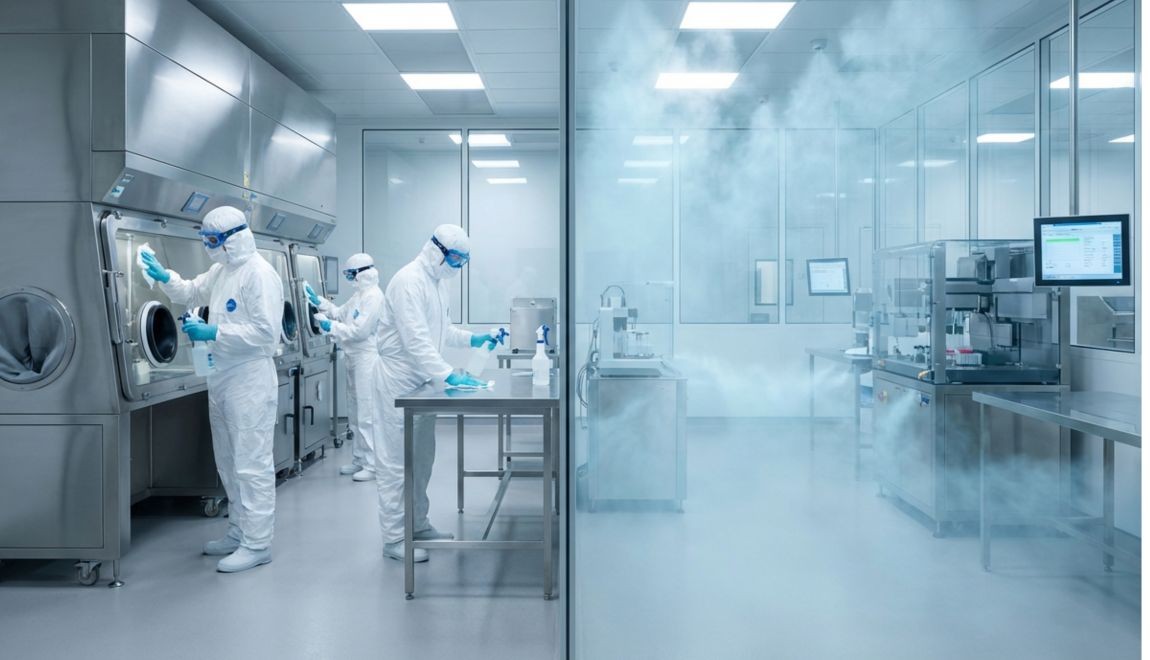 In cleanroom and biopharmaceutical environments, triple cleaning is a trusted and widely adopted standard.
It plays a critical role in contamination control strategies (CCS), supporting the removal of contamination and helping facilities maintain environmental monitoring within acceptable limits.
As facilities continue to evolve—whether through increased production demands, more complex equipment, or heightened regulatory expectations—there is a growing focus on how to make these established processes even more effective.
One approach gaining traction is the addition of sporicidal fumigation using vaporized hydrogen peroxide (VHP/VPHP) as a final step following triple clean. (Learn more about CURIS® VHP biodecontamination solutions →)
By building on existing protocols rather than replacing them, facilities can improve coverage, consistency, and overall confidence in their contamination control strategy.
Prefer to watch instead of read? Here's a full video of this article.
Why Triple Clean Remains Foundational
Triple clean protocols are designed to create consistency. They guide teams through structured cleaning steps, incorporate disinfectants and sporicides, and align with cGMP expectations.
Just as importantly, they are validated through environmental monitoring, providing confidence that contamination levels remain within acceptable limits.
For routine operations, this approach remains both effective and necessary.
The Real Limitation Isn’t Effort—It’s Coverage
Manual cleaning depends on physical access and consistent application. In complex cleanroom environments, that can create natural gaps in coverage.
These gaps often occur in:
- Areas that are difficult to physically reach, such as equipment geometries that limit full surface contact
- Particles in the air that are not captured within the wipedown
As a result, even well-executed cleaning may leave certain areas untreated—not due to lack of effort, but due to the inherent limitations of manual processes.
In some cases, recontamination pathways may also contribute. However, improving coverage and consistency is often the most immediate and controllable way to regain stability. (Explore how CURIS portable systems help improve coverage in complex environments →)
The Hidden Cost of Repeating the Same Approach
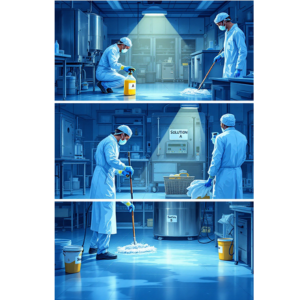 In some cases—particularly during environmental monitoring excursions—standard processes may need to be repeated to regain control.
However, each additional round introduces more than just time.
Manual cleaning involves multiple passes—application, dwell time, wiping, and often additional wiping to remove residues from disinfectants and sporicidal agents such as IPA and other EPA-registered chemistries. Across an entire cleanroom, this becomes a highly repetitive and labor-intensive process. (See how CURIS System supports faster turnaround with biodecontamination services →)
As cleaning and disinfection cycles are repeated, timelines extend, production is delayed, and variability can increase—while still relying on the same physical limitations around access and coverage.
At that point, the question shifts from effort to effectiveness:
Are all critical surfaces truly being reached?
Why Surface Preparation Still Comes First
Effective disinfection always begins with proper cleaning.
EPA-registered disinfectant labels and CDC guidance require the removal of dirt, grime, and organic material prior to disinfection. Residual soil can interfere with disinfectant performance and reduce overall efficacy.
This is why triple clean remains essential.
It prepares the environment so that any subsequent disinfection step—whether manual or automated—can perform as intended. While this step can be labor-intensive, it is critical for ensuring that downstream processes deliver consistent results.
Sporicidal Fumigation with Vaporized Hydrogen Peroxide (VHP/VPHP) as a Complement to Triple Clean
Once surfaces are properly prepared, fumigation adds a final layer of control.
Sporicidal fumigation using vaporized hydrogen peroxide (VHP/VPHP) introduces an automated biodecontamination cycle that distributes EPA-registered disinfectant throughout the entire space. (Explore CURIS® generators and integrated systems →)
Because fumigated disinfectant moves with airflow, it reaches areas that manual cleaning cannot consistently access, including hidden surfaces and airborne particulates. (Learn how CURIS System decontamination services can support your facility →)
The process is controlled and repeatable, helping ensure consistent dwell time and distribution across cycles.
Environmental monitoring remains the primary measure of success for most facilities. Fumigation supports those outcomes by improving overall coverage and consistency—helping facilities return to acceptable EM levels more reliably.
To verify sporicidal efficacy, fumigation cycles can also be validated using biological indicators placed in challenging or worst-case locations. These indicators demonstrate ≥6-log microbial reduction under defined conditions, reinforcing confidence in the process.
This approach also supports audit readiness by providing documented, repeatable processes aligned with FDA expectations for contamination control and validated disinfection practices, as well as with EU GMP Annex 1 guidance, which emphasizes a holistic Contamination Control Strategy (CCS).
The result is not a replacement for manual cleaning—but a more complete and reliable approach to contamination control.
Reducing Downtime Without Reducing Thoroughness
Time is often the most immediate pressure during a contamination event.
Repeated cleaning cycles can extend recovery timelines from hours to multiple days, particularly when validation and retesting are required between steps.
By contrast, fumigation cycles can typically be completed within hours or less than a day. Because the process is controlled and repeatable, it reduces the need for multiple interventions.
The result is a faster return to operation—without compromising compliance or validation standards.
The Best Practice: Enhance, Don’t Replace
The most effective contamination control strategies don’t replace proven methods—they build on them.
A practical approach begins with standard cleaning or triple clean to remove gross contamination and prepare surfaces. Fumigation can then be applied as a final step to ensure comprehensive coverage throughout the space.
Together, these steps create a more complete and reliable process—one that addresses both visible contamination and hidden risk areas.
Key Insight: Cleaning prepares the surface. Fumigation ensures complete coverage.
If you're ready to give this clean-then-fumigate pairing a defined structure, our companion article, Beyond Triple Clean: Why Your Deep-Clean Protocol Deserves a Defined Framework, shows how the same two steps map directly to EU GMP Annex 1 expectations as a documented, two-phase framework.
When Should You Consider Adding Fumigation?
Fumigation becomes particularly valuable when existing processes are being stretched beyond their typical limits.
This often includes situations such as:
- Environmental monitoring excursions that persist despite repeated cleaning
- Equipment or facility layouts that limit manual access
- Newly constructed or modified spaces requiring higher assurance
- Scenarios where faster turnaround is needed to return to production
In each case, the goal is not to replace what works—but to extend it.
Frequently Asked Questions
Is fumigation required after a triple clean?
Fumigation is not required in all situations, and triple clean remains a validated and effective process. However, when additional assurance is needed, it can be added as a final step to enhance coverage and consistency.
Does fumigation replace manual cleaning?
No. Manual cleaning is required to remove soil and prepare surfaces. Fumigation builds on that foundation by extending coverage.
How is fumigation validated in cleanroom environments?
Fumigation is validated using biological indicators to demonstrate ≥6-log sporicidal efficacy, often alongside post-treatment environmental monitoring.
What advantages does fumigation provide over repeat cleaning?
Fumigation improves coverage and consistency, often reducing the need for repeated cleaning cycles and shortening downtime.
When should a facility consider adding fumigation?
When excursions persist, access is limited, or faster recovery is needed, fumigation can enhance existing protocols.
Does fumigation leave residues that need to be removed?
Fumigation using CURIS Hybrid Hydrogen Peroxide™ technology does not leave harmful residues requiring post-treatment wipe-down.
Final Thought
Triple cleaning remains an essential part of contamination control.
But when challenges arise, the solution isn’t always to do more of the same.
It’s to add the layer that ensures nothing is missed.
Fumigation provides coverage where manual cleaning cannot reach, validation where confidence matters most, and speed when time is critical.
The question isn’t whether triple clean works.
It’s how to make it work even better.
Want to see how fumigation can integrate into your existing protocols?
Talk to a CURIS System expert about enhancing your triple clean strategy.