Why Animal Research Facilities Can't Afford Inconsistent Decontamination
Animal research facilities are purpose-built for control. Controlled environment, controlled access, controlled health status. And yet, for many facilities, decontamination—one of the most critical control points in the entire operation—still relies on manual processes that introduce the variability those facilities work so hard to eliminate.
If your sentinel program has ever flagged an unexpected pathogen, or if you’ve had to interrupt a study due to a suspected contamination event, you already know the downstream cost. Lost animals, lost data, timeline delays, and the institutional pressure that follows.
The problem usually isn’t intent. It’s inconsistency.
Prefer to watch instead of read? Here's a full video of this article.
The Decontamination Challenge in Animal Facilities
Animal research environments pose a contamination-control challenge that many standard facility protocols were not designed to address. Between cohorts, rooms must be fully decontaminated—not just cleaned. That distinction matters. Cleaning removes visible debris. Decontamination reduces the microbial burden to a level that protects the next study population.
When that process depends on manual application—backpack spraying/fogging, wiping, or spray-and-wait approaches—coverage is limited by what staff can physically reach, how consistently the protocol is followed across shifts, and how much time is realistically available between cohort transitions.
Cage wash areas, procedure rooms, and barrier transfer zones are all high-risk points. So are the airlocks and transition areas where contamination commonly enters.
A Note on Vaporized Hydrogen Peroxide
Many animal research facilities are already familiar with vaporized hydrogen peroxide (VHP/VPHP) as a decontamination method—and some have moved away from it or handed it off to outside vendors because traditional high-concentration systems come with real operational complexity. Specialized training, bulky equipment, and safety considerations can make those systems difficult to manage in-house for most facilities.
That’s a reasonable response to a real constraint. But not all hydrogen peroxide-based systems are the same. Hybrid Hydrogen Peroxide™ technology operates differently from legacy high-concentration VPHP systems—with a safety and operational profile that changes the calculus for in-house use. If your facility stepped back from VPHP for those reasons, it’s worth understanding what’s changed. See our full breakdown of VPHP technology differences →
What Autonomous Decontamination Changes
Autonomous biodecontamination systems address these challenges at the process level—not just the surface level.
A validated, cycle-based approach delivers hybrid hydrogen peroxide™ vapor throughout the treatment space, reaching surfaces, equipment interiors, and areas that manual methods routinely miss. Because the cycle is defined and repeatable, every room gets the same treatment—regardless of who runs the process or when.
For AAALAC-accredited facilities and those operating under institutional biosafety protocols, that repeatability has a second benefit: it generates the cycle data and documentation your compliance program needs. Cycle parameters, exposure time, and completion status are logged automatically—not reconstructed from memory after the fact.
Protecting Study Integrity Between Cohorts
The most common application in animal research facilities is between-cohort room decontamination. When one animal group completes a study and the next group is scheduled to move in, the window for decontamination is often tight. Autonomous systems can run overnight or during facility downtime—without requiring staff presence—and deliver consistent, documented results within that window.
That matters for specific pathogen-free (SPF) programs, for barrier facilities where health status is actively maintained, and for any research program where sentinel animal results are tied to facility cleanliness.
Where CURIS® Generators Fit
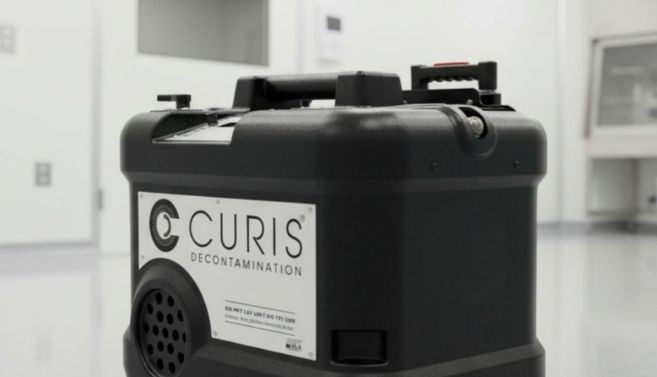
The CURIS® generator (CURIS 3) is designed for exactly these environments. Portable and self-contained, it deploys into the treatment space, runs a defined cycle using Hybrid Hydrogen Peroxide™ technology, and produces a timestamped cycle report. No manual spraying or wiping. No reliance on staff coverage variability. No guessing whether the far corner of the room received adequate exposure.
For animal facilities already managing tight timelines, rotating cohorts, and compliance documentation requirements, autonomous decontamination isn’t an upgrade—it’s a gap in the current process that’s waiting to be closed.
What does your between-cohort decontamination process look like today?
If it relies on manual methods, it’s worth a closer look. Talk to CURIS System about your facility.
Frequently Asked Questions
Q: Is autonomous biodecontamination validated for animal research environments? A: Yes. Cycle-based vaporized hydrogen peroxide systems can be validated for specific room configurations, and CURIS systems are appropriate for use in barrier facilities, procedure rooms, and cage transfer areas.
Q: Can the CURIS® generator run in a room with equipment present? A: Yes. The system is designed to treat whole laboratory spaces, including equipment interiors and hard-to-reach surfaces that manual methods routinely miss.
Q: How long does a typical cycle take in an animal facility room? A: Cycle time varies by room volume and configuration. CURIS experts can provide application-specific guidance based on your facility layout.
Q: Does autonomous decontamination replace my existing cleaning protocols? A: No. Biodecontamination works alongside your cleaning program—cleaning removes physical debris, biodecontamination addresses microbial burden. Both are part of a complete contamination control strategy.