Device + Chemistry: The Regulatory Link Your Fill-Finish Biodecontamination Program Should Understand
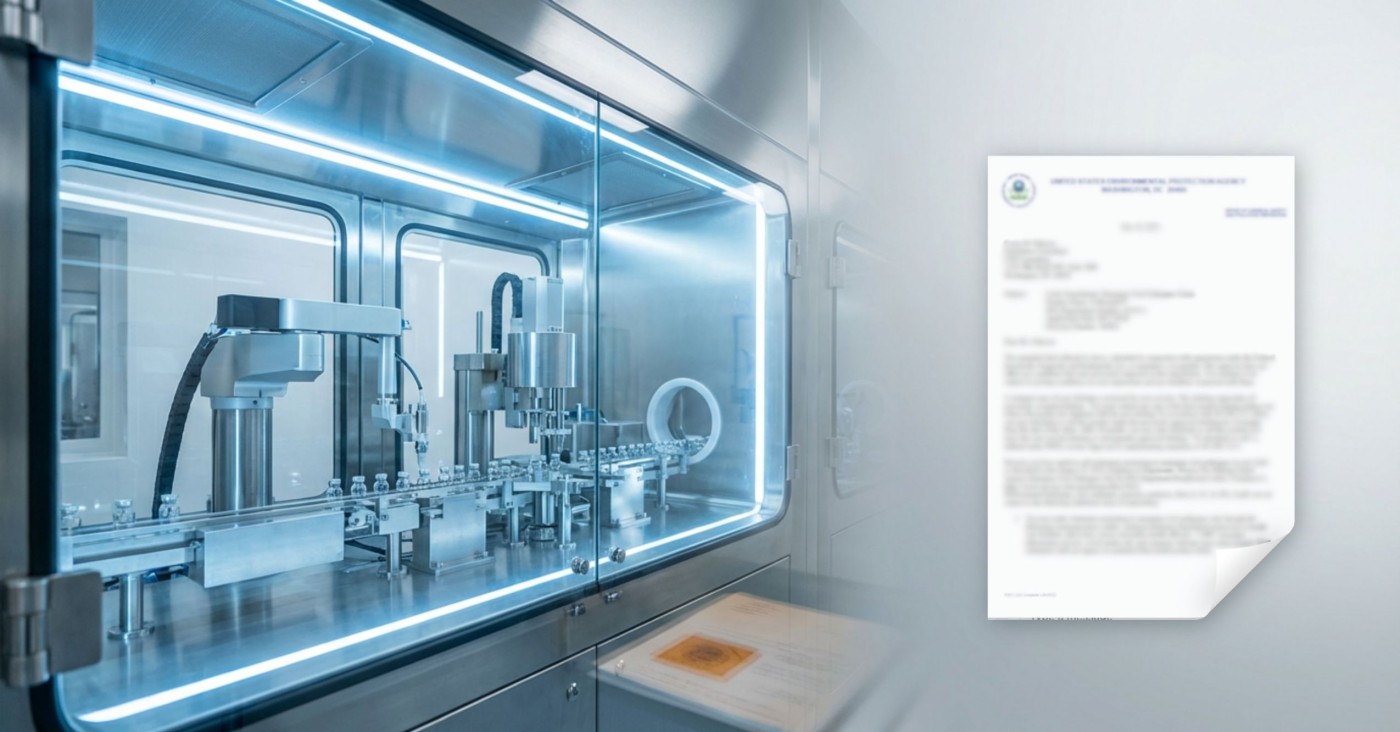
If your fill-finish facility runs a validated vaporized hydrogen peroxide cycle inside an isolator, you operate at an intersection of two regulators. The FDA reviews your GMP process. The EPA governs pesticidal chemistry—and, since 2020, has been clearer about how it treats devices that produce a pesticidal effect. Understanding the line between the two is part of a defensible biodecontamination program today in a way it may not have been five years ago.
This post walks through what the distinction actually says, where common documentation gaps appear, and what to look for in your own program.
Two Regulators, Two Different Questions
The FDA and EPA are not asking the same question about your cycle.
The FDA's interest is the validated process inside your isolator—contact time, distribution, residual levels, cycle parameters, and the cGMP framework that supports your product's sterility assurance. That review produces your validation package and your aseptic process authorization.
The EPA's interest is separate. Under FIFRA Section 2(u), a substance is a pesticide when it is intended to prevent, destroy, or mitigate a pest, and FIFRA defines pest to include microorganisms. A validated GMP cycle does not resolve that definition. The two jurisdictions run in parallel, and a strong posture in one does not close a gap in the other.
It is common, and understandable, to assume FDA review of the process extends to the chemistry. It does not.
The Device + Chemistry Linkage
The more consequential change is in how the EPA treats the device.
Since 2020, EPA has taken an increasingly active public position on pesticide devices. The agency issued Compliance Advisories on devices in 2020 and again in February 2023, the latter describing a "significant increase" in pesticide devices being sold or distributed in the US with "substantial non-compliance" with FIFRA requirements.¹ In the same period, EPA issued Stop Sale, Use, or Removal Orders against device distributors—including a 2020 order against a company that resolved with a $6.99 million civil penalty—and opened roughly 60 FIFRA criminal cases in fiscal year 2020 alone.² The throughline in these actions is the agency's position that devices producing a pesticidal effect, and the chemistries they use to produce it, are regulated together.
This matters for fill-finish operations. A vaporized hydrogen peroxide (VPHP) generator or nebulizer paired with an unregistered, off-the-shelf reagent-grade hydrogen peroxide is a device-and-chemistry combination that is harder to defend today than it was before 2020. The chemistry is being used as a pesticide. The device is producing the pesticidal effect. Under current agency positions, the two are linked.
An EPA-registered hydrogen peroxide solution, designed and documented for use with a specific device, addresses that linkage directly.
Where 40 CFR § 152.6 Fits—and Where It Does Not
Some facilities and integrators point to 40 CFR § 152.6 as grounds that the chemistry question does not apply. That section excludes certain liquid chemical sterilants intended solely for use on critical or semi-critical medical devices—instruments introduced into or in contact with the human body.
A fill-finish isolator is not a medical device in that sense. It is pharmaceutical manufacturing equipment. A reading of § 152.6 that extends the exclusion to the isolator itself, or to the room around it, is not a settled position. If your program relies on that interpretation, it is worth reviewing with regulatory counsel who works at the EPA/FDA intersection.
What Auditors May Look For
Auditor practice varies. Some reviewers focus on the validated process only. Others ask for the EPA registration number of the hydrogen peroxide used inside the isolator and expect to see AOAC-method sporicidal efficacy testing with independent third-party review.
The practical question for your program is not whether a specific auditor will ask. It is whether you can answer quickly if one does. That answer is cleaner when the chemistry carries its own registration and documentation, rather than when it relies on a § 152.6 reading or on process validation alone.
Why a Registered Pairing Simplifies the Audit Picture
Apart from the jurisdictional question, an EPA-registered chemistry designed for a specific device offers three practical advantages.
- Your documentation arrives intact. Registration requires AOAC-method sporicidal efficacy testing, ingredient disclosure, stability and shelf-life data, and independent third-party review. That file supports your validation package without a separate build.
- A single product covers more than one application. Fill-finish facilities often use the same hydrogen peroxide family for isolator cycles and for suite- or room-level biodecontamination. Room-level use routinely requires an EPA-registered sporicide already. A single registered solution removes the need to manage two qualification pathways.
- Audit conversations shorten. Presenting an EPA registration, AOAC-method efficacy data, and a validated VPHP cycle together is a different conversation than explaining why none of it applies.
What to Review in Your Own Program
A practical documentation review would confirm:
- Whether the hydrogen peroxide source used inside the isolator is EPA-registered as a sporicide.
- Whether the device producing the pesticidal effect is documented with a specific, compatible chemistry.
- Whether any reliance on 40 CFR § 152.6 has been reviewed by regulatory counsel.
- Whether AOAC-method sporicidal efficacy data supporting your chemistry is independent and current.
- Whether the same chemistry covers adjacent room- or suite-level applications in your facility.
These are documentation questions, not process questions. A validated cycle can be sound and still have a gap in the chemistry file.
The CURIS® Position
CURIS System's vaporized hydrogen peroxide cycles run with CURoxide™, an EPA-registered hydrogen peroxide solution developed specifically for use with CURIS® technology. The device and the chemistry are paired by design, and the documentation—registration, AOAC-method efficacy data, stability, and independent third-party review—is built for the audit conversation regulatory programs increasingly expect.
If you are reviewing your current hydrogen peroxide supply chain or want to understand where your program sits against current EPA positions on devices and pesticidal chemistry, you can contact us to walk through what it looks like for CURIS systems.
This post addresses general regulatory principles and the current direction of EPA policy and enforcement as of publication. It is not legal advice and does not constitute a formal opinion on any facility's compliance posture. Facilities seeking a determination on FIFRA applicability, the 40 CFR § 152.6 exclusion, or the EPA's current position on devices producing a pesticidal effect should consult regulatory counsel with experience in both EPA and FDA pharmaceutical manufacturing compliance.
FAQ
Q: Does FDA validation of my VPHP cycle cover the hydrogen peroxide chemistry?
A: The FDA reviews the validated GMP process. The EPA governs the pesticidal substance and, under current agency positions, the device producing the pesticidal effect. They are parallel jurisdictions. A strong validation package does not substitute for a registered chemistry.
Q: Can 40 CFR § 152.6 exempt my isolator application from EPA requirements?
A: That exclusion is written for liquid chemical sterilants intended solely for use on critical or semi-critical medical devices—instruments in contact with the human body. Pharmaceutical manufacturing equipment generally does not fit that description. If your program relies on this reading, review it with regulatory counsel.
Q: What has changed since 2020?
A: The EPA has taken a more active public position on devices that produce a pesticidal effect, including enforcement actions, Stop Sale orders, and guidance clarifying that devices and the chemistries they use are considered together. Biodecontamination systems may sit inside that line of thinking.
Q: What is CURoxide™?
A: CURoxide™ is CURIS System's EPA-registered hydrogen peroxide solution, developed for vaporized hydrogen peroxide biodecontamination with CURIS technology. It carries registration, AOAC-method sporicidal efficacy data, stability, and independent third-party review.
¹ EPA, What You Need to Know about Producing, Distributing, or Selling Pesticide Devices, Compliance Advisory, Document #305F22003 (Feb. 2023). ² EPA, Pesticide Registration Manual, Chapter 13 — Devices; EPA Office of Enforcement and Compliance Assurance, FY2020 enforcement reporting.