Setting Your Cleanroom Up for EMPQ Success: How Biodecontamination Strengthens Your Contamination Control Strategy
If you operate a GMP or Annex 1–compliant cleanroom, an Environmental Monitoring Performance Qualification (EMPQ) or equivalent environmental monitoring qualification is expected as part of a compliant program. It is the documented proof that your environmental monitoring system accurately reflects your cleanroom's state of control—and a key area regulators routinely scrutinize.
Prefer to watch instead of read? Here's a full video of this article.
As one industry presentation from Charles River Laboratories put it plainly:
EMPQs are not just a regulatory checkbox. They are a proactive investment in quality, compliance, and patient safety—and the foundation of your future contamination control strategy (CCS).
To meet EU GMP Annex 1 expectations, EMPQs are typically performed at defined intervals (commonly 6 months for Grades A/B and 12 months for Grades C/D, based on industry practice and risk assessment). They are also triggered by significant changes to the facility or HVAC systems, major shutdowns, and large or unexplained environmental excursions. In other words, an EMPQ is not a one-and-done event. It is a recurring checkpoint that your CCS has to be ready for, again and again.
That readiness starts well before the sampling plates go down. It starts with how you decontaminate the space. This is true whether you're requalifying an existing classified cleanroom or preparing a controlled non-classified (CNC) space for its very first GMP qualification—the initial EMPQ is often the most consequential one a facility will ever run.
What an EMPQ Is Actually Asking You to Prove
An EMPQ asks three questions of your facility:
- Is the environment consistently within microbial and particulate limits?
- Are your monitoring systems reliable under both at rest and in operation conditions?
- Can you produce documented evidence of control that will hold up under inspection?
EMPQs are often structured in three phases. The first, a Baseline phase, is essentially a "before" picture: you've cleaned the room, and now you sample it to understand what microbes remain present before any production activity begins. The second phase, an Initial qualification, tests the room under both at rest and in operation conditions to confirm it meets its ISO or Grade classification. The third, Extended qualification, is the long game—six to twelve months of ongoing data to show the room stays in control across different seasons and conditions.
Each phase depends on a known, repeatable starting point. If your decontamination process produces a different result depending on who performed it or what time of day it ran, every phase that follows inherits that variability—and so does your trending data.
Where Variability Enters the Picture
EMPQs are designed to detect contamination risk. But they are also, in practice, quite good at detecting inconsistency in the processes meant to control contamination.
Manual disinfection workflows can be a common source of that inconsistency when not tightly controlled or standardized:
- Coverage depends on technician technique
- Contact times vary
- Surfaces in shadowed or hard-to-reach areas may receive less exposure than the validation protocol assumed
None of this means manual cleaning is wrong—it remains essential for visible soil and routine sanitization—but it does mean that the residual microbial baseline going into an EMPQ phase can shift from one event to the next.
When that baseline shifts, several things follow.
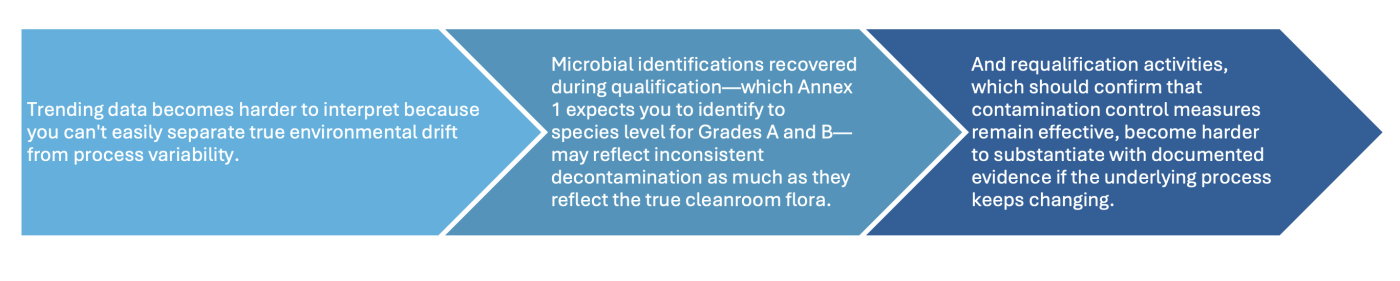
The Decontamination Step Before Phase I
Phase I baseline sampling happens post-clean—after your decontamination protocol runs and before controlled processes are introduced. That "before" picture becomes the reference microbiota your facility trends against for years to come. It also informs the risk assessments referenced throughout Annex 1.
And according to BioPhorum's industry-harmonized EMPQ guidance, the cleaning, disinfection, and decontamination program is one of the factors that must be considered when designing in-operation EMPQ sampling—not just preparation for it. Having a documented, repeatable biodecontamination protocol in place before your EMPQ begins isn't optional housekeeping. It's a design input.
If your facility already uses a rigorous sporicidal cleaning approach—such as a triple-clean protocol incorporating a hydrogen peroxide–based sporicidal agent—you already understand that thorough, coverage-focused decontamination before a qualification event is not optional. (For a deeper look at why structured sporicidal cleaning matters for contamination control, see our earlier post: Triple Clean + VPHP: A Cleanroom Contamination Control Strategy That Works.)
Biodecontamination takes that rigor further. An automated, documented biodecontamination cycle run before Phase I sampling can provide a more defensible baseline—one that is designed to reflect the true environmental flora of your cleanroom rather than the variability of the team that prepared it.
New Construction and CNC-to-GMP Conversions
The most consequential EMPQ a facility runs is often its first one. New construction projects, and conversions of controlled non-classified (CNC) spaces into GMP-classified cleanrooms, both depend on an initial qualification that establishes the environmental baseline the facility will be measured against for years to come.
Until a space has completed the full qualification sequence—IQ, OQ, PQ on the room and its systems, followed by the EMPQ on the environmental monitoring program—it can’t be considered fully qualified for GMP manufacturing use. The EMPQ is what produces the documented evidence that the monitoring program accurately reflects a state of control under both at rest and in operation conditions.
For new facilities, it's also worth noting that action limits are required during EMPQ, while alert levels—which typically rely on historical data—may be provisional or based on limited data during initial qualification. That makes the quality of your starting baseline even more critical: the data generated during your initial EMPQ becomes the historical foundation against which everything downstream is measured.
For facilities making this transition, the decontamination process used during qualification matters in a way it might not in routine operation.
An automated, documented biodecontamination cycle provides a new or converting facility with a more repeatable starting point. Parameters are known and recorded. Distribution of the active agent is driven by the system, not by operator technique. The contribution to the qualification baseline is consistent—and easier to characterize in a risk assessment.
Two Ways to Bring CURIS Into Your Protocol
Whether your facility has existing biodecontamination equipment or is building a new protocol from scratch, there are two direct ways to incorporate CURIS:
>
|
CURIS Biodecontamination Services |
CURIS Systems & Devices |
|
|
Best For |
Facilities without in-house equipment |
Facilities wanting on-demand, in-house capability |
|
Investment |
No capital investment required |
Equipment purchase or lease |
|
Deployment |
Scheduled around your production windows |
Triggered on demand, integrates into routine protocols |
|
Documentation |
Fully documented cycle provided |
Cycle parameters programmed and recorded in-house |
|
Validation |
No in-house system validation required |
In-house system validation applies |
In both cases, cycle parameters are programmed and documented, disinfectant distribution is system-driven rather than operator-dependent, and cycles can run off-hours without competing with production.
What a Documented Biodecontamination Cycle Adds Across EMPQ Phases
For an EMPQ, a repeatable, documented biodecontamination cycle matters in a few specific ways.
Phase I—Baseline:
Gives baseline sampling a more stable, more defensible starting point. The microbiota you characterize is more likely to reflect the true environmental flora of your cleanroom rather than variability introduced during preparation.
Phases II & III—Initial and Extended:
Gives you something concrete to reference when an inspector asks how you know your contamination control measures are working consistently. Annex 1's risk assessment framework calls for detailed knowledge of the facility, the operations involved, and routine monitoring data. An automated process with documented parameters is straightforward to characterize, and the cycle records it generates—parameters, run data, and performance reports—give your team the documented evidence needed to demonstrate consistent control during an inspection.
Requalification:
When requalification is triggered—by the calendar, a major shutdown, HVAC maintenance, or an unexplained excursion—having a documented decontamination step that can be deployed quickly and consistently shortens the path back to a qualified state. This is particularly relevant for facilities building requalification activities into slower production windows such as year-end shutdowns or seasonal slowdowns.
Building EMPQ Readiness Into Your CCS
EMPQs are not a regulatory checkbox. They are the foundation of your contamination control strategy, and the data they generate should feed directly into how you trend, investigate excursions, and update your CCS over time.
Biodecontamination—whether delivered through CURIS Biodecontamination Services or a CURIS in-house system—is one input into that strategy. It is not a replacement for routine cleaning, not a guarantee of passing qualification, and not a substitute for the risk assessments and sampling plans the EMPQ process requires. What it offers is a more consistent, more defensible process upstream of qualification, making the data downstream easier to trust.
If your facility is preparing for an upcoming EMPQ, recovering from a shutdown, or building requalification activities into your next slower season, it is worth evaluating where process variability is currently entering your environment—and what removing it could mean for your next qualification event.
To learn more about how CURIS can support your cleanroom's EMPQ readiness through biodecontamination services or in-house systems, contact our team.
Sources: Charles River Laboratories, "Back to the Basics with EMPQs," Microbial Contamination and Control Conference; BioPhorum, "Environmental Monitoring Performance Qualification in New Facilities: An Industry-Harmonized Approach" (2020).