Custom Facility Integration
Request a Quote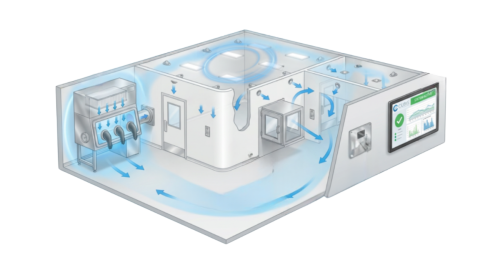

Customized Integrated Solutions
Integrated Hydrogen Peroxide Biodecontamination Systems for Cleanrooms, Laboratories, and Controlled Environments
Flexible biodecontamination integration—from portable system coordination to fully automated facility infrastructure.
CURIS integrated biodecontamination systems use Hybrid Hydrogen Peroxide™ (HHP™) technology to deliver vaporized hydrogen peroxide in controlled, repeatable, validated cycles—either directly within a space or through fixed injection points. The CURIS® Integration Architecture™ scales from portable system coordination to fully automated, facility-wide biodecontamination, so pharmaceutical cleanrooms, biosafety laboratories, vivariums, and research facilities can match automation to their operational needs.
What is an Integrated Biodecontamination System?
An integrated biodecontamination system uses vaporized hydrogen peroxide to deliver controlled, repeatable decontamination cycles within a room, chamber, or controlled environment. Depending on the configuration, vapor is delivered directly from a portable generator inside the space, introduced through fixed injection points from outside the room, or coordinated with facility systems such as HVAC, door interlocks, and automation controls. Integrated systems are designed to reduce variability, improve repeatability, and align decontamination with facility workflows.
Where Integrated Biodecontamination Systems Are Used
Why Facilities Move to Integrated Biodecontamination
Integrated hydrogen peroxide vapor biodecontamination systems are widely used across regulated and research environments:
- Pharmaceutical cleanrooms: aseptic processing, fill-finish manufacturing, isolators
- Biosafety laboratories (BSL-2 to BSL-4): room and equipment decontamination
- Vivarium facilities: animal rooms, cage wash, and transfer spaces
- Biotechnology laboratories: cell and gene therapy research environments
- Containment research facilities: high-risk and specialized applications
- Material airlocks (MALs) and chamber-based decontamination systems
These environments require consistent, documented contamination control processes to protect product quality, research integrity, and personnel safety.
Why Facilities Move to Integrated Biodecontamination
Compared to manual disinfection or portable-only approaches, integrated systems improve throughput and consistency while reducing operator dependency. Facilities adopt integrated biodecontamination to gain:
- More repeatable, validated cycles and reduced operator variability
- Improved process consistency across rooms and operations
- Faster turnaround between operations and higher material throughput
- Better documentation and reporting for compliance
- Alignment with facility automation and safety systems
How Integrated Biodecontamination Works
Facility Considerations for Integrated Systems
Implementing an integrated biodecontamination system may require coordination with facility infrastructure, including:
- HVAC operation and airflow control
- Room pressurization and isolation during cycles
- Door sealing and interlock systems
- Environmental conditions such as humidity
Depending on the level of integration, CURIS can:
- Provide system design requirements
- Collaborate with facility and engineering teams
- Support full turnkey integration when needed
CURIS® Integration Architecture™
Three Levels of Integrated Biodecontamination
Integrated biodecontamination is not a one-size-fits-all approach. Facilities vary in their need for automation, infrastructure, and operational control.
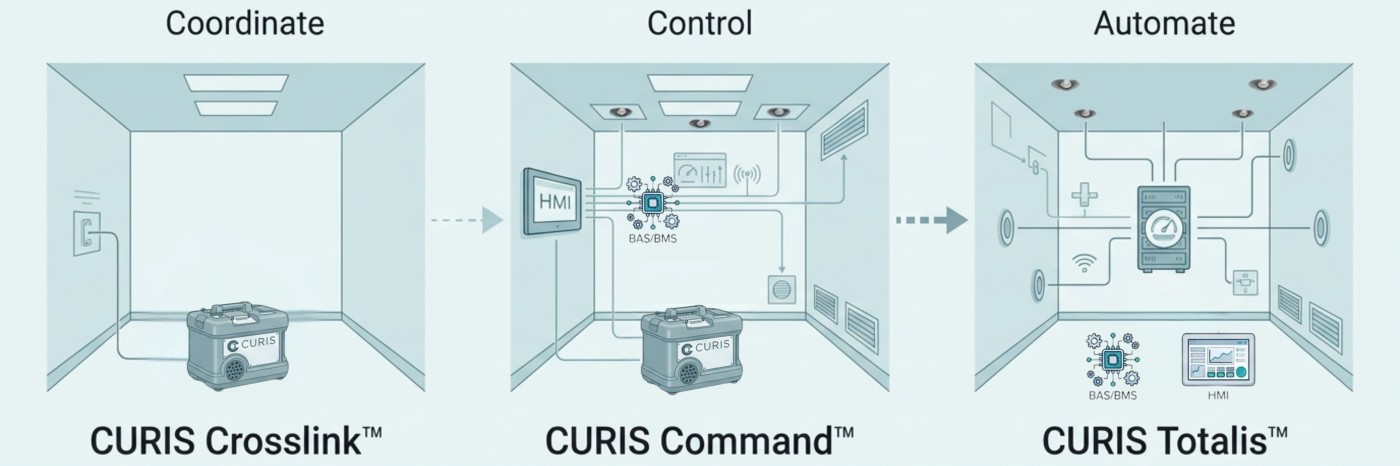
The CURIS platform supports this range through three defined levels of integration—allowing facilities to implement what they need today while maintaining a clear path to more advanced automation.
| CURIS Crosslink™ | CURIS Command™ | CURIS Totalis™ | |
|---|---|---|---|
| Integration level | Coordinate | Control | Automate |
| Best for | Coordinated biodecon with existing workflows, no permanent infrastructure | Structured control and repeatable cycles across rooms or processes | Fully automated, facility-wide biodecon built into building infrastructure |
| Delivery | Portable-powered; deployable inside or outside the room | Portable-powered with centralized control | Permanently installed, fixed infrastructure |
| Automation | Repeatable cycles; optional facility communication | Centralized HMI control; pre-programmed cycles | Lights-out or operator-initiated; full BAS/BMS integration |
| Facility systems | Optional (HVAC response, door interlocks) | Coordinated control (HVAC, doors, safety interlocks) | Full BAS/BMS across whole space or facility |
| Fixed install? | No | No (portable-powered or docked in place) | Yes |
| Documentation | Repeatable cycle execution | Enhanced cycle documentation and reporting | Centralized reporting across rooms, suites, or facilities |
Integration With Facility Infrastructure
Depending on the integration level, CURIS systems can interact with:
- Building automation systems (BAS/BMS)
- HVAC and air handling systems
- Door interlocks and access controls
- Environmental monitoring systems
- Reporting and compliance platforms
This allows facilities to align biodecontamination with operational workflows and safety requirements.
Designed for Controlled Environments
CURIS systems support a wide range of controlled environments:
Pharmaceutical & Biopharmaceutical
- Cleanrooms and aseptic suites
- Fill-finish and manufacturing
- Isolators and material airlocks
Biosafety & Containment Labs
- BSL-2, BSL-3, BSL-4 laboratories
- Infectious disease research environments
Vivarium Facilities
- Animal holding rooms
- Cage wash and transfer areas
Biotechnology & Research
- Cell and gene therapy labs
- Translational research facilities
Across these environments, CURIS provides a consistent biodecontamination technology platform aligned with facility operations.
Room Decontamination for Biosafety Laboratories and Vivariums
Biosafety and vivarium environments often require room-level biodecontamination to protect personnel, research integrity, and animal health.
Integrated systems support:
- Whole-room decontamination cycles
- Equipment and chamber decontamination
- Coordinated workflows with safety systems
By delivering vapor through controlled methods and supporting repeatable cycles, CURIS systems help maintain consistent contamination control procedures.
Flexible Integration for Real-World Facilities
Every facility operates differently—some prioritize portability and flexibility, others require automation and centralized control. Some environments also need multiple transfer strategies, separate workflows for sensitive materials, or coordination with existing facility classifications. The CURIS® Integration Architecture™ accommodates these variations through flexible configurations, so you implement the right level of integration—without overengineering or oversimplifying the solution.
Frequently Asked Questions
What is an integrated biodecontamination system?
A system that delivers vaporized hydrogen peroxide in a controlled, repeatable manner, often integrated with facility infrastructure.
What is the difference between portable and integrated systems?
Portable systems operate independently within a room, while integrated systems coordinate with facility systems or use fixed infrastructure, such as wall or ceiling mounted nozzles, for improved consistency and automation.
Can CURIS systems integrate with building automation systems?
Yes. Depending on the system level, CURIS solutions can communicate with or control BAS/BMS systems, HVAC, and facility controls.
Do all systems require fixed installation?
No. CURIS Crosslink™ and Command™ systems are portable-powered or docked in place, while Totalis™ is fully fixed.
What is VPHP (vaporized hydrogen peroxide)?
VPHP, or vaporized/vapor-phase hydrogen peroxide, is hydrogen peroxide dispersed as a vapor to decontaminate rooms, chambers, and equipment. CURIS uses Hybrid Hydrogen Peroxide™ (HHP™) technology to deliver low-concentration (7%) hydrogen peroxide vapor with no harmful residues.
What is the difference between CURIS Crosslink™, Command™, and Totalis™?
Crosslink™ provides coordinated integration with minimal infrastructure, Command™ adds centralized control and automation, and Totalis™ delivers fully automated, facility-wide biodecontamination built into building infrastructure.
Which industries use integrated hydrogen peroxide biodecontamination?
Pharmaceutical cleanrooms, biosafety laboratories (BSL-2 to BSL-4), vivariums, biotechnology and cell and gene therapy labs, and containment research facilities.
Request an Integration Assessment
Understand which level of integration is right for your facility.
Speak with a CURIS specialist to evaluate your environment, workflows, and automation goals.
👉 Talk to a CURIS Integration Specialist