How to Safely Decontaminate Cell Sorters: CURIS Vapor System Proven with BD and Baker
Why Decontaminating Cell Sorters Matters
Cell sorters are high-precision instruments used across research labs, pharmaceutical cleanrooms, and biologics manufacturing. Equipped with internal tubing, flow systems, and aerosol management systems (AMS), these devices are designed to handle and separate delicate cell populations with precision. However, their complexity also makes them prone to trapping contamination—especially in hard-to-reach internal areas.
Prefer to watch instead of read? Here's a full video of this article.
Cell sorters play a critical role in processes such as...
- Purifying cell therapy products, where only viable, healthy cells must be isolated for patient use
- Removing dead or damaged cells during vaccine development, to ensure purity and enhance immune response accuracy
If not properly decontaminated between runs, residual contamination can compromise sample integrity, cross-contaminate batches, or delay time-sensitive production schedules.
These aren’t just quality risks—they can lead to regulatory noncompliance, lost batches, and costly shutdowns.
When Is Decontamination Required?
In addition to routine contamination control, cell sorter decontamination is often required before key maintenance activities.
For example, most often:
-
Cell sorters require HEPA filter changes at least every five years
-
Service or repair work cannot be performed until the system is fully decontaminated
This means decontamination isn’t just a best practice—it’s a prerequisite for maintaining and servicing critical equipment. Without it, routine maintenance can be delayed, increasing downtime and operational risk.
What’s Wrong with Traditional Cleaning Methods?
Manual disinfection—spray and wipe—can’t reach the sorter’s internal chambers and tight tubing. Even thorough cleaning of outer surfaces may leave behind up to 60% of bioburden, according to CDC-cited research.
More aggressive sterilants, like formaldehyde or chlorine dioxide gas, are corrosive. In fact, BD explicitly prohibits their use on certain models, including the FACSDiscovery S8™, due to material damage risks.
CURIS® HHP™ Decontamination: A Proven and Safer Alternative
CURIS’ Hybrid Hydrogen Peroxide™ vapor system offers high-level disinfection without compromising your equipment. It uses a 7% hydrogen peroxide formula to achieve a >6-log sporicidal reduction while staying safer for internal components.
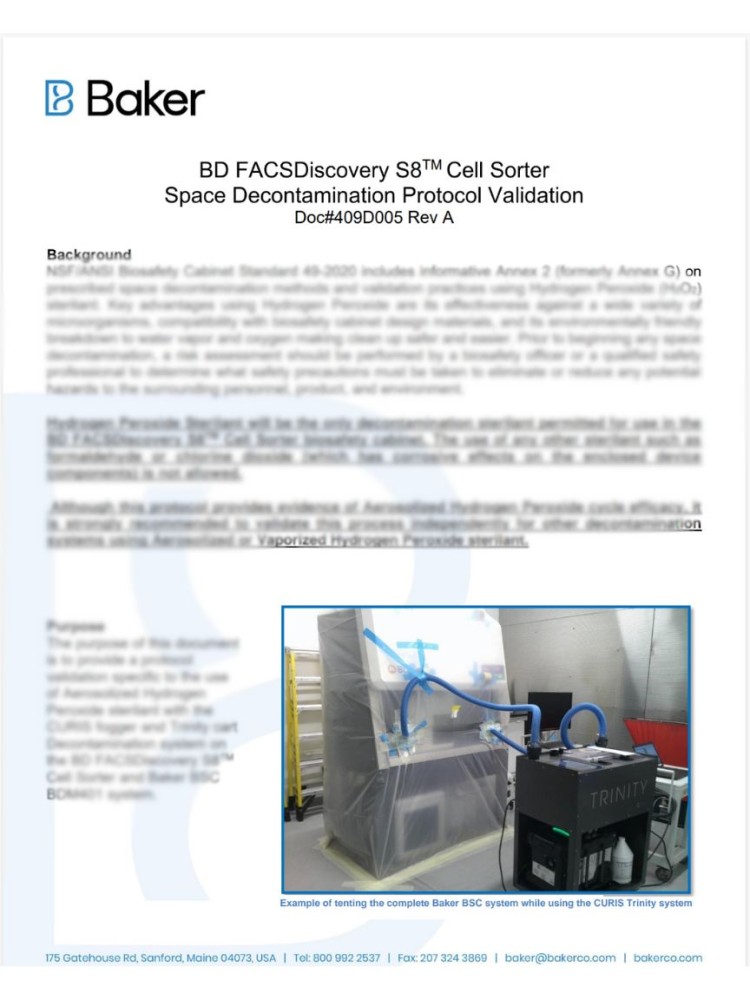 CURIS was tested and validated for the BD FACSDiscovery S8™ Cell Sorter inside a Baker BDM401 biosafety cabinet (BSC), following NSF/ANSI Standard 49 Annex 2.
Validation highlights:
- 15 test cycles using CURIS TRINITY™ and CURoxide™
- Biological indicators placed in 14+ hard-to-reach areas
- 100% inactivation rate across all indicators
- No observed impact on equipment performance or materials
This protocol is now recognized as a validated option for decontaminating BD cell sorters.
Safe for Sensitive Instruments
Unlike >35% peroxide systems, CURIS’ lower concentration vapor reduces common damage risks, such as:
- gasket cracking or seal degradation,
- residue buildup in filters,
- damage to sensitive electronics, or
- long off-gassing times.
CURIS’ formula and cycle design are engineered for material compatibility—making it ideal for high-investment instruments like cell sorters, BSCs, and cleanroom robotics.
Real-Life Application: Inside a BD FACS + Baker BSC Setup
In the validated test setup:
- The BD cell sorter was enclosed and tented inside the Baker cabinet
- CURIS vapor was delivered using preset, automated cycles
- Internal airflow and temperature were monitored
- Biological indicators confirmed complete coverage—even in sample chambers and exhaust filters
Common Questions About Cell Sorter Decontamination
Can I use hydrogen peroxide on a BD cell sorter?
Yes—if it’s low-concentration, has no other active ingredients like heavy metals (silver), and is validated for use. CURIS’ HHP™ system meets these standards and is endorsed by BD for this purpose.
How do I decontaminate a cell sorter without damaging it?
Avoid corrosive chemicals. Use vapor systems like CURIS that have been tested for both efficacy and material safety.
Is this compatible with biosafety cabinets?
Yes. CURIS has been validated in numerous BSCs, including Baker, NuAire, and Germfree (as presented at CETA), and meets NSF/ANSI BSC standards.
How often should I decon my cell sorter?
This depends on usage and risk profile. Many cleanroom facilities use vapor decontamination before critical operations, between batches, or after any contamination event.
What do our customers say?
"If I had known it would be this easy, I would have done this months ago."
Upgrade Your Decon Process—Without Sacrificing Equipment
CURIS gives you a safer, proven way to fully decontaminate sensitive lab instruments—backed by data, manufacturer validation, and smarter automation.
🔬 See the validated protocol in action or talk with our experts
👉 Schedule a Demo or Request a Quote